


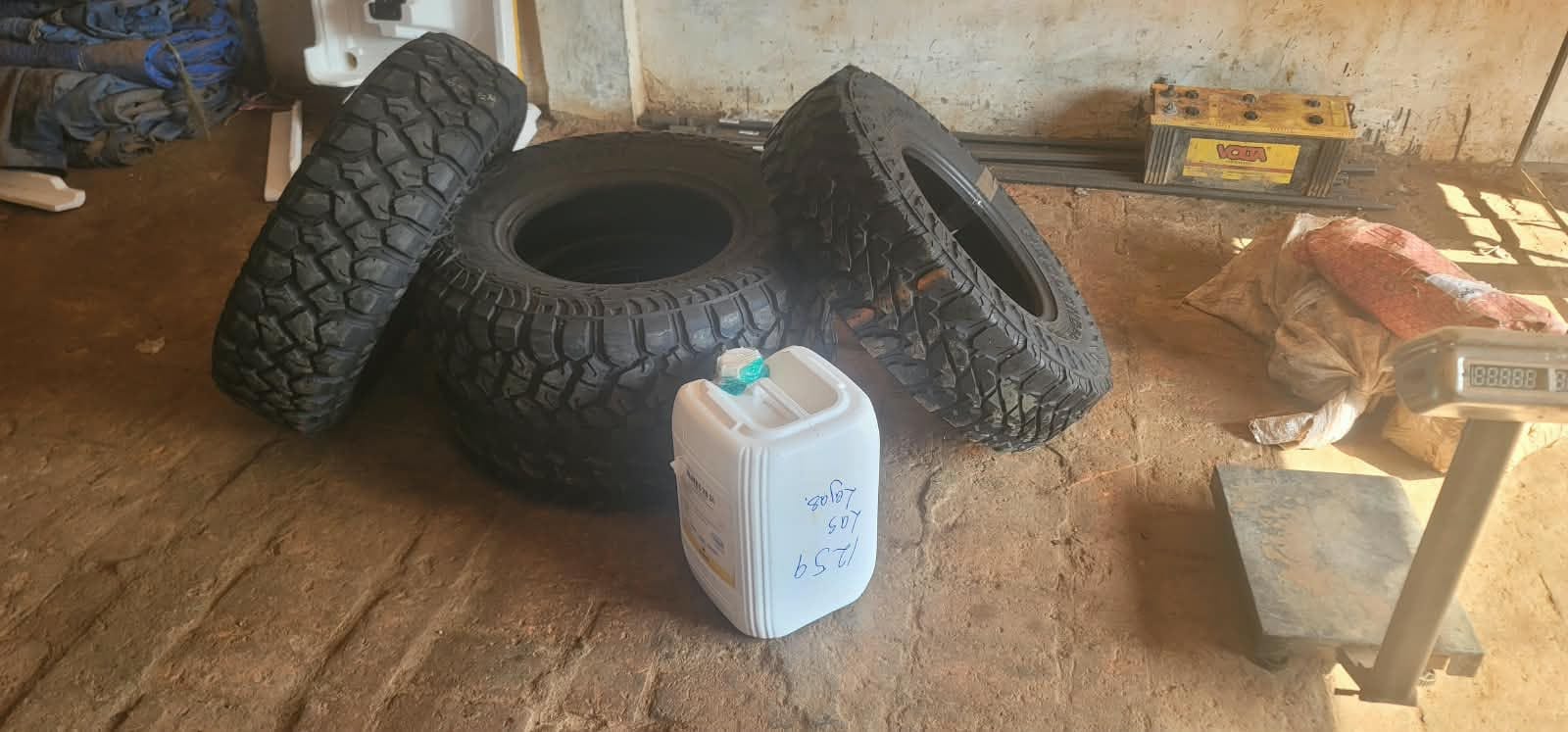
There's a bus that leaves Santa Cruz every Thursday night. It carries passengers headed for the pueblos along the edge of the Bolivian Amazon — San Ignacio, Concepción, San Martín — and whatever else people need moved. Sacks of rice. Engine parts. This week, it's carrying four truck tires for a park ranger named Marcelo, who will nurse a battered '97 Nissan Patrol — he calls it his Hummer, though it comes through on WhatsApp as la Hammer — three hours round trip to a crossroads called La Laja to pick them up. He's bringing an air compressor so he can keep the current tires inflated en route, then nurse the beast back to La Florida to install them.
I bought those tires used — two pairs, Yokohama and an Italian brand, Davanti — in Santa Cruz. I'm not a logistics company. I'm not an NGO with a supply chain. I'm a photographer with a Bolivian debit card and a WhatsApp thread. But somehow I've become a node in a network that has no name, no org chart, and no budget — just people who know people who need things moved from one end of the Amazon to the other.
Amazon to Amazon. The e-commerce giant ships to my door in Maryland. And from there, by some alchemy of trust and bus schedules and rangers who know which road is passable this week, it reaches a guardaparque station in one of the most remote protected areas on Earth.
A few months ago, none of this existed.
The borochi — the maned wolf, Chrysocyon brachyurus — was a name in a fifteen-year-old study and a set of coordinates no one had revisited. The park had its own problems. The last serious survey of the species in Noel Kempff Mercado was conducted by the veteran Smithsonian vertebrae zoologist, Louise Emmons, between 2001 and 2011. The data went dark after that. Not because the animal disappeared, but because no one went back to look.
I didn't start this with a plan. I started it with a question I couldn't stop asking: is the borochi still there?
The question led me to Kathia Rivero at the Museo de Historia Natural Noel Kempff Mercado, who had been wondering the same thing. It led me to Pamela Carvajal at SERNAP — the biologist who processes research permits and who, somewhere along the way, stopped being a bureaucratic contact and started being a friend who sends me bird photos. It led me to Lorena Kempff, whose family name is on the park and who showed up wanting to help before I'd asked.
And it led me, one afternoon in the museum, to a meeting where the institutional pieces clicked into place — a carta de intención, a team roster, a shared understanding that this work mattered enough to formalize.
This morning I hit send.
Seventy pages. A formal solicitud de autorización de ingreso to Bolivia's Servicio Nacional de Áreas Protegidas. Cover letter addressed to the new director. Proposal. Passport. Vaccination card. A bank deposit receipt for 100 bolivianos — about eight dollars at today‘s rate — which is what it costs to formally request permission to enter a national park for science.
Eight dollars and months of conversations. Months of voice messages from a ranger who reports trail conditions from a place with no cell signal, relayed when he rides his motorcycle to the one hilltop that catches a bar. Months of a biologist in La Paz patiently explaining which forms go where. Months of a museum scientist digging through archives for the coordinates of camera traps that were set fifteen years ago and may or may not still be standing.
I couldn't type after I pressed send. Adrenaline hands. The kind you get when something stops being an idea and starts being a commitment.
The thing about informal networks is that they run on trust, not contracts. Marcelo — the ranger, the one with la Hammer, the one whose camp I sat in back in August — doesn't work for me. I don't work for the museum. The museum doesn't control SERNAP. Nobody reports to anybody. What holds it together is that each person decided, independently, that this was worth doing.
That's how most things actually work in the parts of Bolivia I know. The formal architecture exists — there are offices and stamps and deposit receipts — but the current that moves things forward is personal. A biologist who believes in the project tells a colleague. A park director who remembers the last study signs a letter. A guardaparque who has lived in the park for thirty years says yo tengo que buscármela aquí — I have to figure things out here — and means it as both hardship and pride.
I'm one of the carriers now. Not of cargo, exactly — though the four tires are real, and so are the twenty liters of gasoline I'm sending for the motorcycles and boat to ferry them. What I carry is the connection between the Amazon that ships to your door and the Amazon where a maned wolf crosses a savanna at dusk, unaware that anyone is trying to find it again.
The solicitud is in. Now we wait for the selva.


