


Kodachrome
Thursday, October 22 · Trinidad
I'm awake at 4:37, thanks to a late coffee. In the dark I go hunting for a bed in Concepción for tonight. One option is Teresita Suites, where William and I stayed in August. The other is the Gran Hotel Concepción, where our wedding party stayed when my wife and I married at the Jesuit mission church in December 2019. The Gran Hotel will cost twice as much, but it has a great breakfast buffet. In August, rooms at the Teresita were 180 Bs, about $16 at that day's informal rate of 11.2 to the dollar. We were spending bolivianos bought days earlier at 11.9, though. Budgeting travel here is a moving target.
When the light comes, I walk out to find two street scenes I photographed on my first visit to Trinidad, in November 2001. I find both corners, but the morning is gray, with none of the color I remember. Sometimes recollections of better times are actually true. Paul Simon's "Kodachrome" plays somewhere in the back halls of my mind.
The way back follows an arroyo where people once fished. It's a stagnant green pond now, because some better-off neighbors filled in part of it upstream to build their houses. On the far bank, a couple of capybaras mingle with domestic pigs, and a dozen kinds of birds work the water. I've left the Nikon behind, and in this light the iPhone will do. Near the plaza, Suárez Hermanos is embossed high on a corner building, once a wealthy family's casona. A side door stands open onto the old courtyard, where a school has moved in. Like the building, it is showing its age.
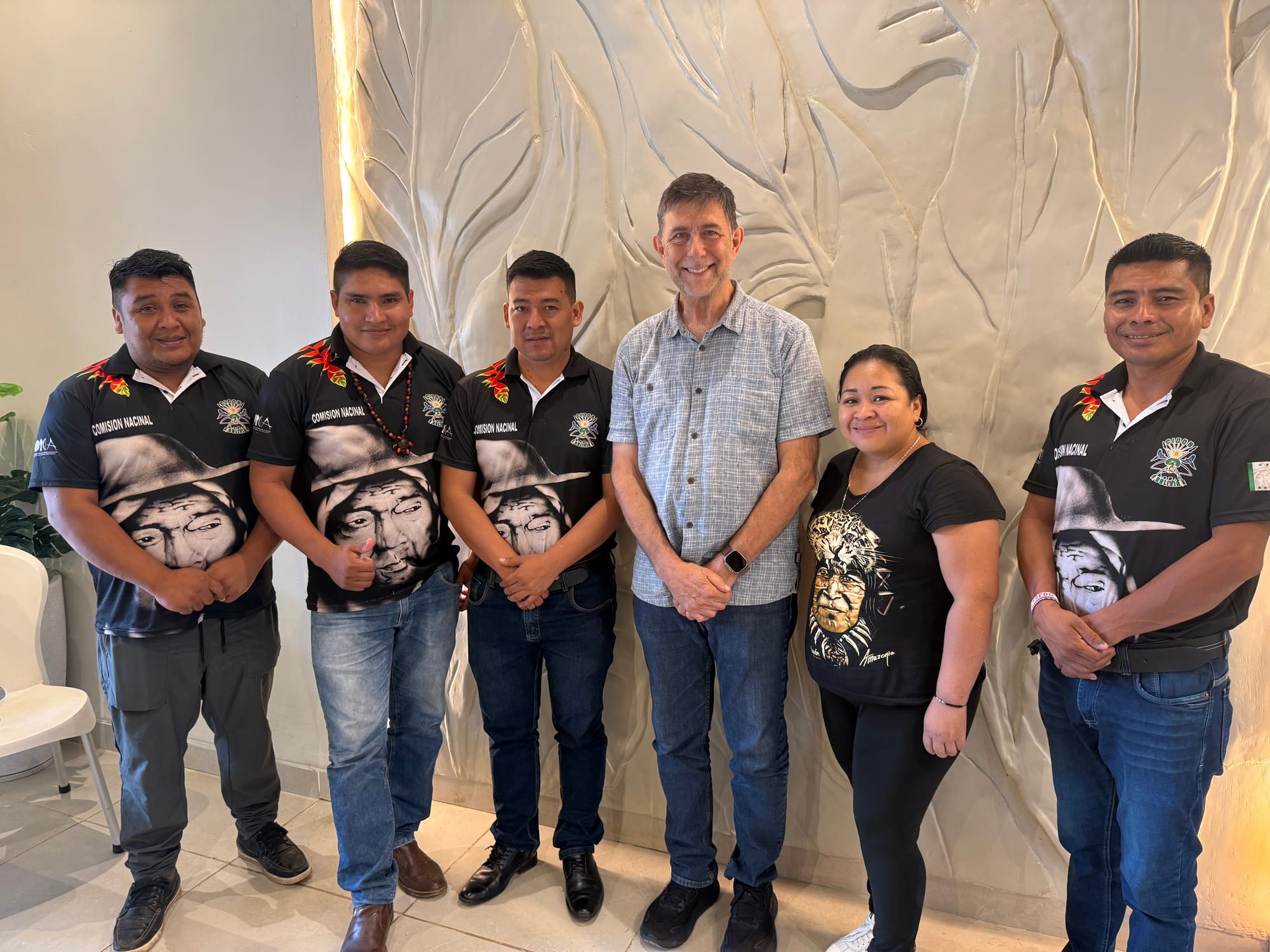
Mr. Borochi at breakfast
Sebastian has brought breakfast sandwiches and, at last, coffee. I spend an hour on the road ahead. The morning road report is in, and Marcelo has checked with Elmar, who drove the route the day before. It's fine for our two-wheel drive. Meanwhile the CIDOB breakfast is slipping, because the delegation from Santa Cruz got in late. I have another meeting at 10:30. And Mayko writes that our Starlink is offline. Right. We're still in Bolivia.
When the breakfast comes together, it's warm, though for a while I can't tell which way it will go. CIDOB's leadership lays out how they see their relationship with SERNAP, carefully and without hurry. Their president cites "Ley 385." When I look it up later, it turns out to be Article 385 of the Constitution: where a protected area overlaps an indigenous territory, the two are managed together. In their view, entering such a place is not the government's alone to authorize. They also speak of a younger leadership setting out to rebuild the organization on its founding principles.
Partway through, the president of CPEM-B walks in, the same man who christened me the afternoon before. From then on I'm Mr. Borochi to the whole table. As icebreakers go, it's hard to beat.
By the end of the morning, CIDOB has given the project its support, in writing.
Monte on both sides
We're on the road to Concepción by 11:45. The sky is kind, the Starlink is back, and we can see the road clearly. At 1:30 we cross from Beni into Santa Cruz department, 122 km short of Guarayos. The country flips from one side of the highway to the other. Monte stands on one side, and on the other the land is scraped bare, some of it slowly going back to bush. Within a few hundred meters the sides trade places, and then there's monte all around us again. Every few minutes we pass another vehicle: a cattle truck, a huge yellow tractor, a loaded logging truck parked on the shoulder behind a warning triangle that must once have been bright. Between potholes, I answer an inquiry from my wedding-photography site about a November wedding. One more bowling pin in the air. To pass the long stretches, we've taken to shouting "Borochi!" every time a dog trots along the roadside. So far, the score is dogs plenty, borochis zero.
We top off in Guarayos at three. Past it, ranches spread across rolling hills, and one would be forgiven for not thinking deforestation amid all this beauty. By San Ramón, around five, the dashed center line is mostly a reminder that this is technically a road, as we weave back and forth across it to dodge the potholes.
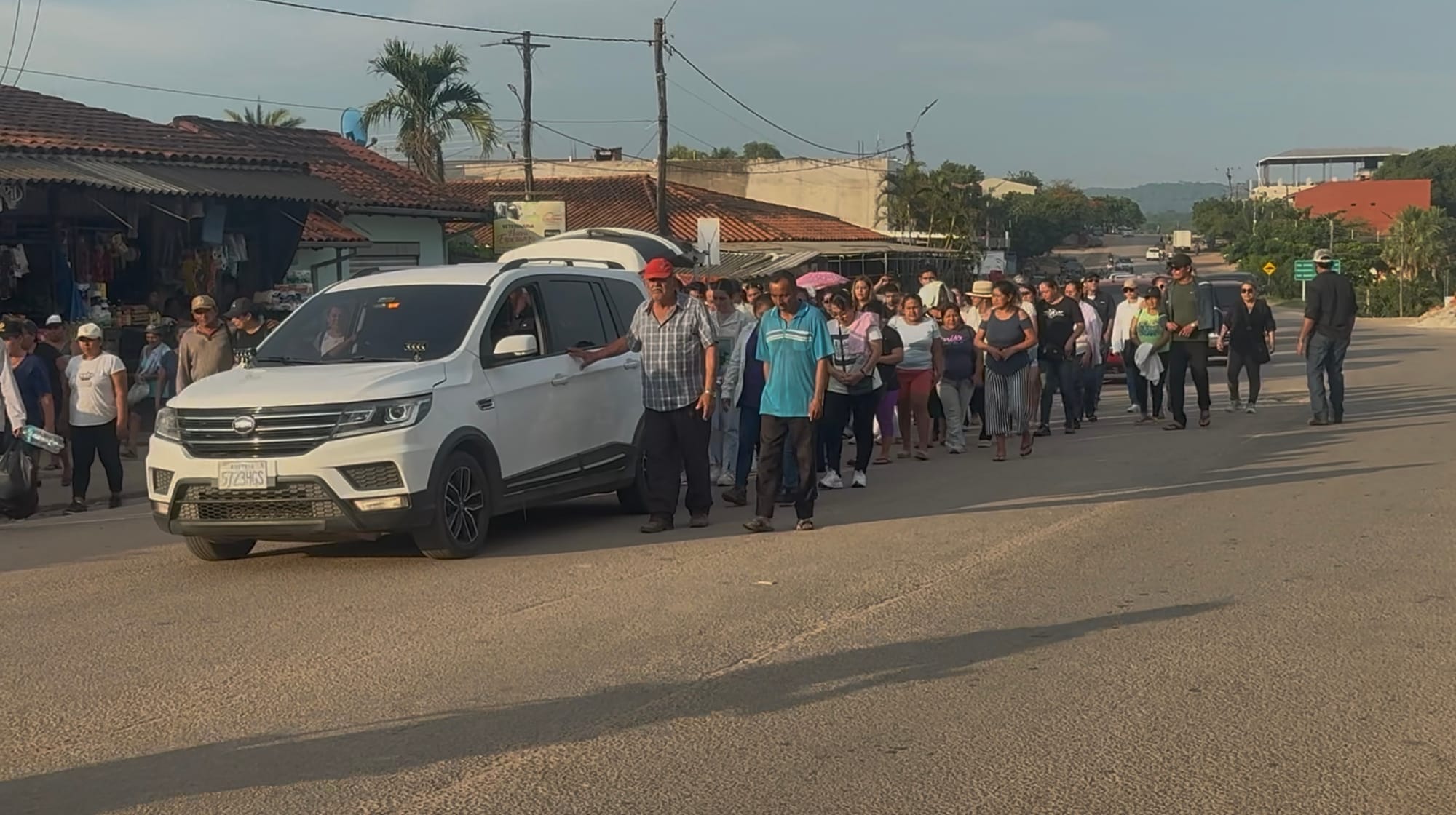
The Sound of Silence
Coming into town, we meet a funeral procession headed the other way: the hearse, and behind it perhaps a hundred people on foot. Then I catch the music, played slowly over a snare drum, and a chill runs down my back. It's "The Sound of Silence."
From San Ramón the road winds up into the green hills of the Chiquitanía. We climb into them at the golden hour, with everything lit as if by design, a world away from where we started the morning. The last stretch is brutal, with potholes as bad as anything on the way to Trinidad. It's worse than in August, probably because of the rains. We roll into Concepción at seven, seven hours after leaving Trinidad, and I'm ready to be horizontal.
First, though, dinner at El Buen Gusto on the plaza, our place since our first visit to Concepción in 2006. The owner knows our faces by now and smiles whenever we appear in the doorway. It's been a long day, and a good one.
Garlic for the snakes
Friday, October 23 · Concepción
Six o'clock, and for the first time in days I've slept well. I'm rested and eager, because tonight it's Florida. I'm looking forward to seeing Marcelo, Elmar, and the guardaparque Nelio, who rode up with William and me on our first visit to the park in February. The morning road report says GO.
Over breakfast, Mayko and I tie up loose ends from Trinidad and send CIDOB the group photo from the meeting. Then I write a quick note to the museo and to my contact at SERNAP about CIDOB's support. It will be public soon, and I want them to hear it from me first. The museo answers first, with congratulations. Support like this, she writes, is both difíciland costoso. And today, she adds, is the museo's 40th anniversary, so I send congratulations right back. A nice synchrony. She asks me to keep them posted from the field, and I'm glad to.
Mayko and Tito head out to lash the fuel bidones more firmly to the roof for the dirt road ahead, and to shop. They pick up sodas and snacks for the road, coca and some cerveza for the folks at the Florida campamento, ice for the cooler, and fresh food for a community that rarely sees it. Marcelo puts in his own order by voice note: a kilo of cheese from San Martín. The day is overcast and breezy, perfect for travel, and Marcelo passes along Elmar's all-clear on the road, which Elmar drove less than 48 hours ago. I have a 10 o'clock call that I'll probably take right about where the asphalt ends. Fingers crossed the Starlink holds.
There may be a special guest in Florida, too: Carola Vaca, Bolivia's first woman park ranger. She began right here in Noel Kempff in 1997 and has nearly thirty years in the country's conservation world. A recent interview fills in the rest. She organized the 6th World Ranger Congress in Santa Cruz in 2009, founded ABOLAC, the guardaparques' association, and spent five years with Proyecto Amazonía, a UNESCO biosphere-reserve project. Next to that résumé, my own foray into her world feels modest indeed.
Yesterday's wedding inquiry turns out to have been phishing. The Zoom invitation pointed to a server in Spain, and from there, who knows where. No problema. The last thing I need is a nervous wedding client on the satellite line from deep in the park. A blessing in disguise.
By nine the sun is breaking through, and Mayko and Tito are back in the courtyard. I pack for the last leg: the Z8 with the 600 PF, plus the 24–120 and a spare battery in a shoulder bag. The inReach Mini 2 goes on and starts tracking, and I send the link to my remote security team: my wife, our two sons and my brother. Tito, meanwhile, has bought two strings of garlic for $2, "to keep the snakes away in camp." You can't argue with the cost-effectiveness.
The dirt road that wasn't
We're out of Concepción at 11:30 with the beer and ice aboard and the cheese order noted. Santa Rosa de la Roca is a little over an hour away, and a few minutes past it, the dirt road turns north to Florida.
Santa Rosa at 12:45, and the station is shut. Concepción had none either when we left; the tanker was due at two. Here, they tell us, fuel will come today, hour unknown. We're under half a tank, so we do what we did in August and find the reseller off the plaza. But, her tanks are empty. We retreat back down the highway toward the gas station and find a reseller. Twenty liters into the tank, but at three times the official price. Even at that, affordable for one who’s own country doesn’t subsidize fuel.
Then the day turns. Word comes that the paperwork for our entry into the park hasn't come through. And one of our team has fallen ill, with what looks like food poisoning. We turn around. By 3:30 we're back in Concepción, where our friend will stay with family who live there. We take a late lunch at El Buen Gusto, of course.
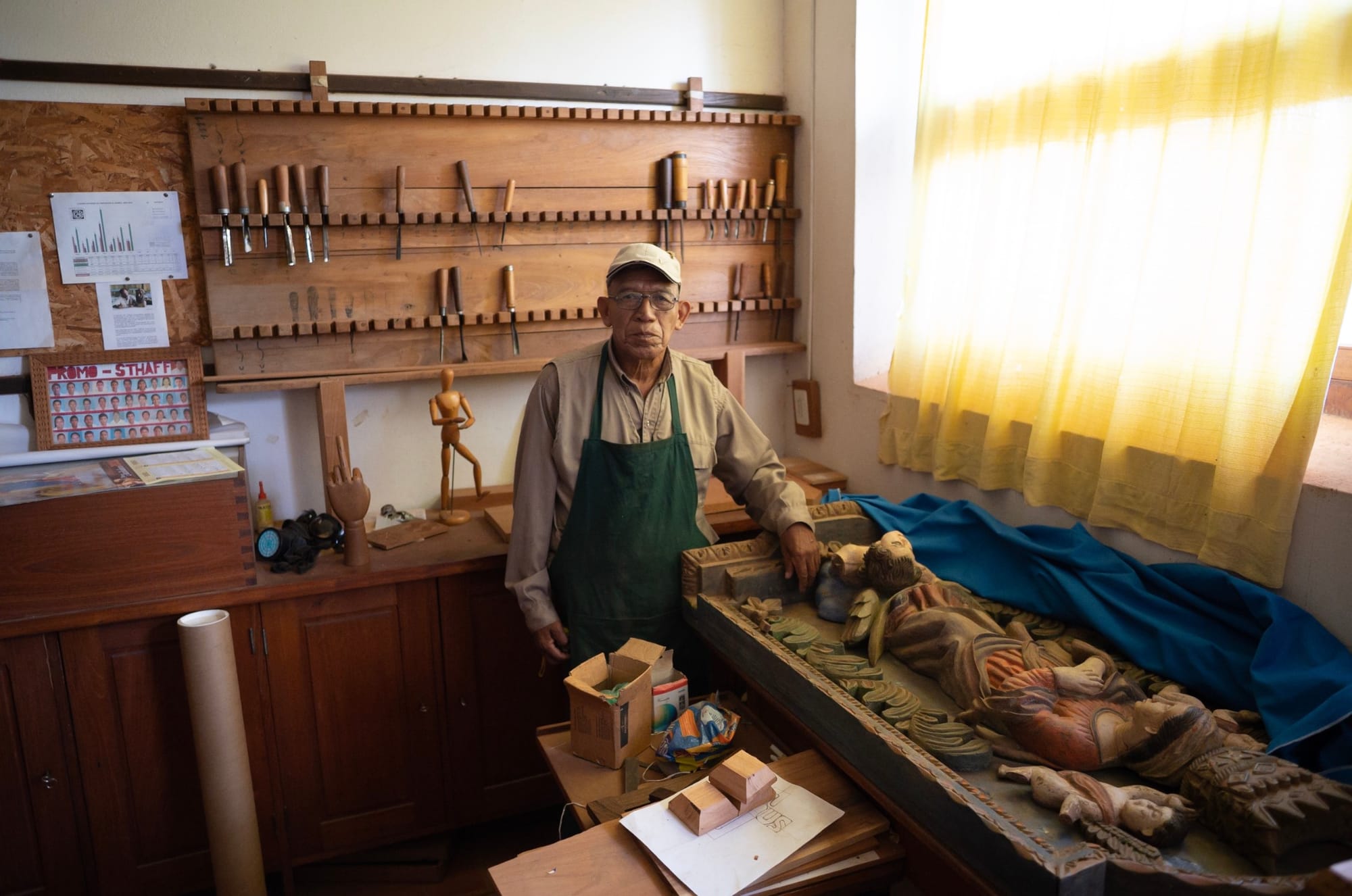
Don Miguel
Since the day has handed us an afternoon in Concepción, I go looking for Don Miguel. He is the master craftsman of the mission's carpentry workshop, known for its carving and for restoring colonial-era pieces. He isn't sure what to make of the tall gringo crossing the street toward him. Within minutes, though, he's telling us everything: his wife's death two years ago, the sad end of the workshop where he spent so many years, the masters who came before him, among them his own long-departed teacher, and the history of the town. His eyes are too weak to carve anymore, he says.
Then he disappears into the house and comes back with a clipboard of big folded sheets, a crucifix he carved, and a small figure of Christ, the first piece he ever made. One by one he unfolds the sheets. They are drawings for carved panels he's been commissioned to make, and he walks us through each one. His crucifixes hang in several places around town, he says, and twenty more have gone abroad.
I've meant to come back to see him for nearly seven years, ever since our wedding in December 2019, shortly after I had first met him in April that year, and photographed him at his bench. I've brought him a tin of Renaissance Wax, the microcrystalline polish that institutions like the British Museum use on their most precious wooden artifacts. He insists he’ll carve me something small, to collect next time I visit, against my protestations. He turns 75 next September, and his family takes my WhatsApp number so they can invite me. I hope I'm here. I leave feeling both complete and sad to say goodbye again.
San Ignacio
We pull into San Ignacio at 7:30, road-weary, and the plaza is a balm for sore eyes. We take a hotel right on it, unload, and cross to Tatiana for dinner. Modern covers of Dean Martin and Frankie Valli drift over the patio. Across the street stands the great white-and-gold Chiquitano cathedral.
After we check in, I recognize the indoor pool. My wife, our two boys and I stayed here in 2009, on a side trip from our younger son's baptism in Concepción.
Showing up
It has been a day of go and no-go. Go: the road report, the open road, a cooler full of ice. No-go: the dry fuel pumps. Go: a reseller off the plaza. No-go: a friend falls ill, and we turn around. And in between, word that the paperwork for the park hasn't caught up with us. Until it does, the trail cams stay in their ziplocks.
On the road east, a voice note from Marcelo: come anyway, hermano, we're waiting for you. So we'll go on to Florida. Not into the park, not yet, but to the people waiting for us there: Marcelo, the comunarios who set aside their days to be ready, and a community that has already given this project more than I've given it. I may not set a single camera this trip. I can still show up.
It's easy to walk away from a borochi, but not so much from a community and those who have carried me this far.


