


I was on my way to Copacabana with my friend Gustavo Zubieta and his wife Lucrecia Urioste, to meet another friend, Esteban Quelima of Challa, on the Isla del Sol.
Two things to do there. Get an update on the invernadero project Esteban and I have been working on. And talk about a memorial on the island for a friend he and I had lost earlier this year, and about leaving his ashes there.
That was the plan for the day. What happened before Copacabana was not in it.
The Crossing
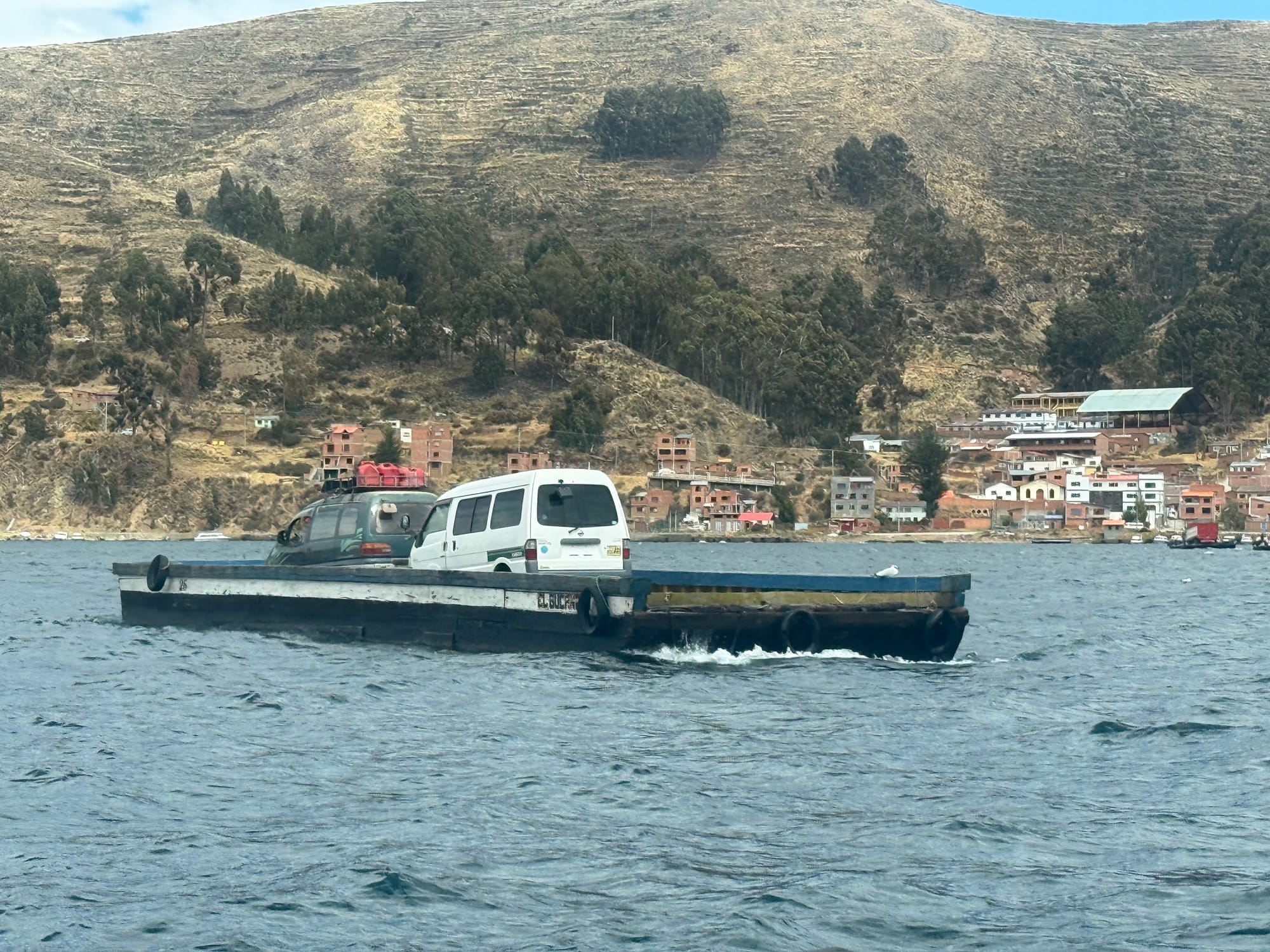
The road from La Paz runs out at San Pablo de Tiquina, where the lake narrows to something under a kilometer and barges do the rest. You drive on, someone waves you into position, and the flat wooden platform (locally known as a barcaza) with an outboard engine takes your vehicle across the Estrecho de Tiquina while you stand at the rail and watch.
It is one of the more entertaining crossings in the world, although on a windy day, particularly if one has the misfortune of sharing the crossing with a bus, the appropriate adjective might be terrifying… more than a few have capsized and sunk into the frigid 10º C (50º F) waters over the years.
Somewhere before we boarded, Gustavo made a phone call. I was half listening, catching only that we were going to meet someone on the other side and that Gustavo expected to be received.
The Gate
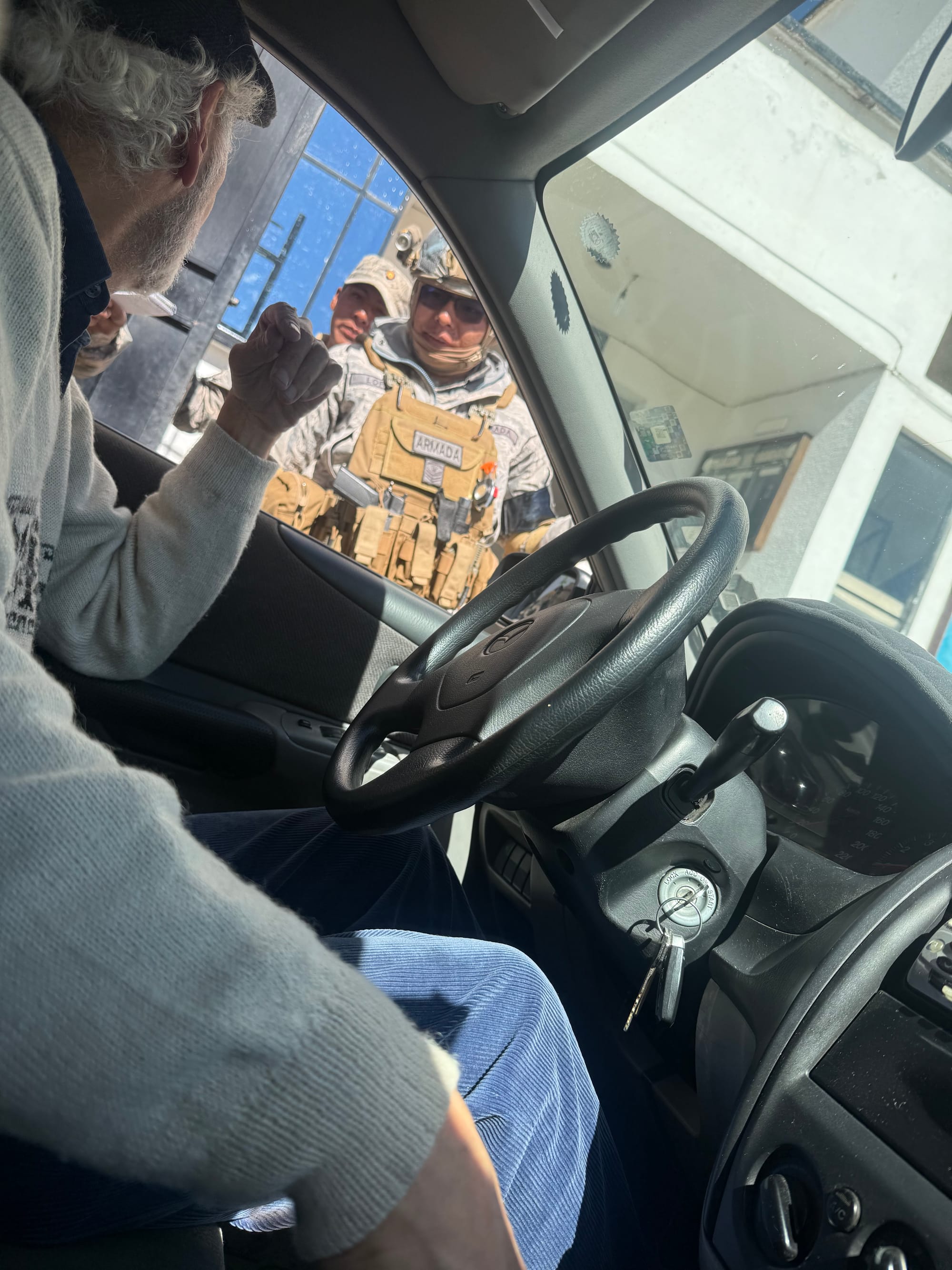
We backed off the barcaza at San Pedro and drove up toward the plaza. At one corner of it are the gates of the Cuarto Distrito Naval "Titicaca."
Bolivia has had no coastline since the War of the Pacific (1879-1884; permanently gone since 1904). It has a navy anyway, and its heart is here.
The gate opened and three naval personnel met us just inside. Gustavo introduced us and said we were expected. One of them offered to ride in with us to show the way, looked at our gear jammed in the back, and Lucrecia on the seat beside it, and thought better of it.
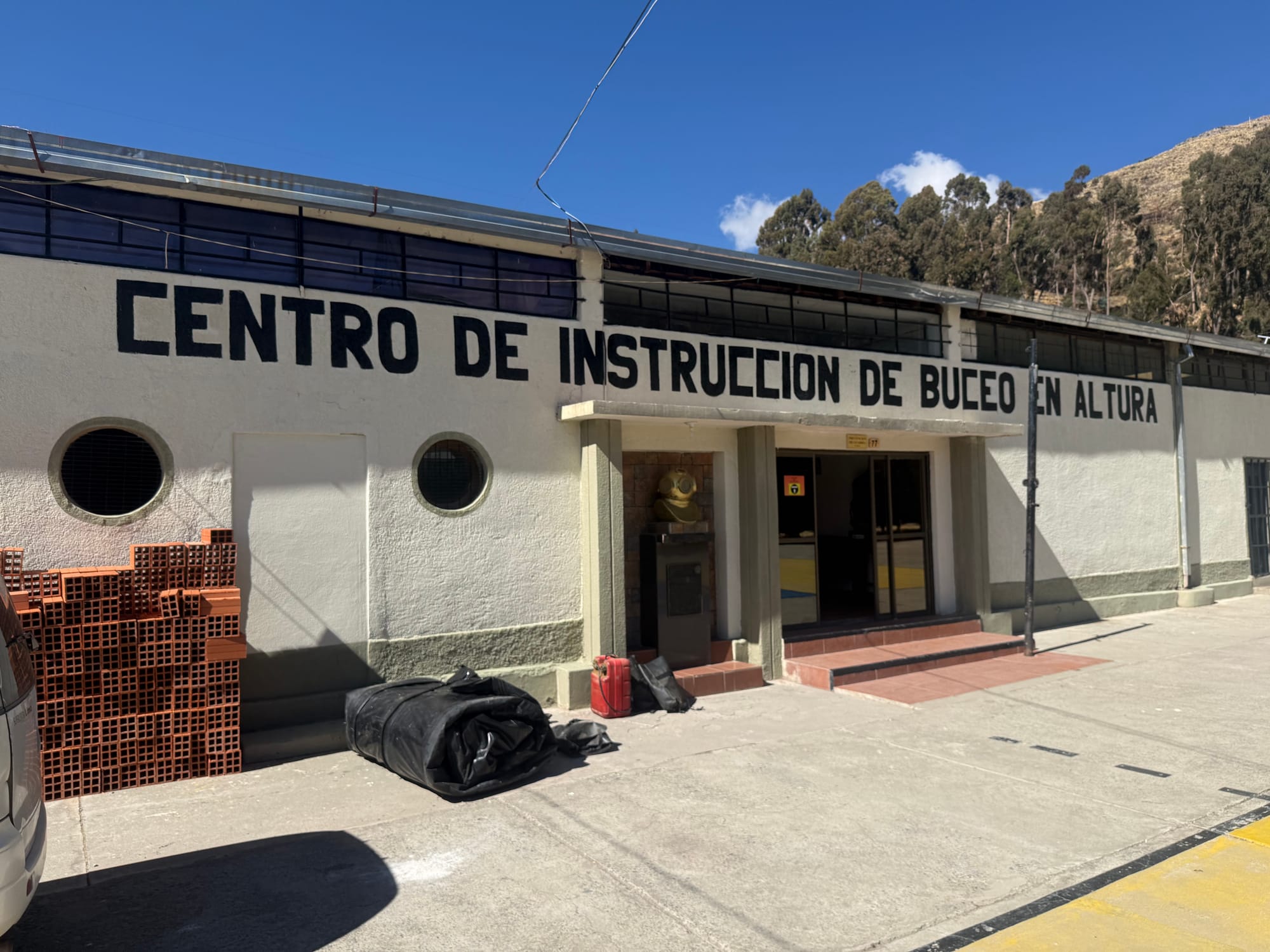
We drove in along a eucalyptus-lined road with the lake on one side, past a parade ground and several vessels drawn up, and parked in front of a building marked, in letters you could read from a distance, CENTRO DE INSTRUCCIÓN DE BUCEO EN ALTURA. Or, simply, CIBA.
An officer greeted us. A moment later Dr. Fabio Muñoz Arandia came out and shook hands all around — a friend of Gustavo’s, and the center’s hyperbaric physician. He has been treating patients in this chamber since at least 2016. The center’s commander, Capitán Max Álvaro Villarroel Muñoz, I would only come to know later, only through news articles.
Inside
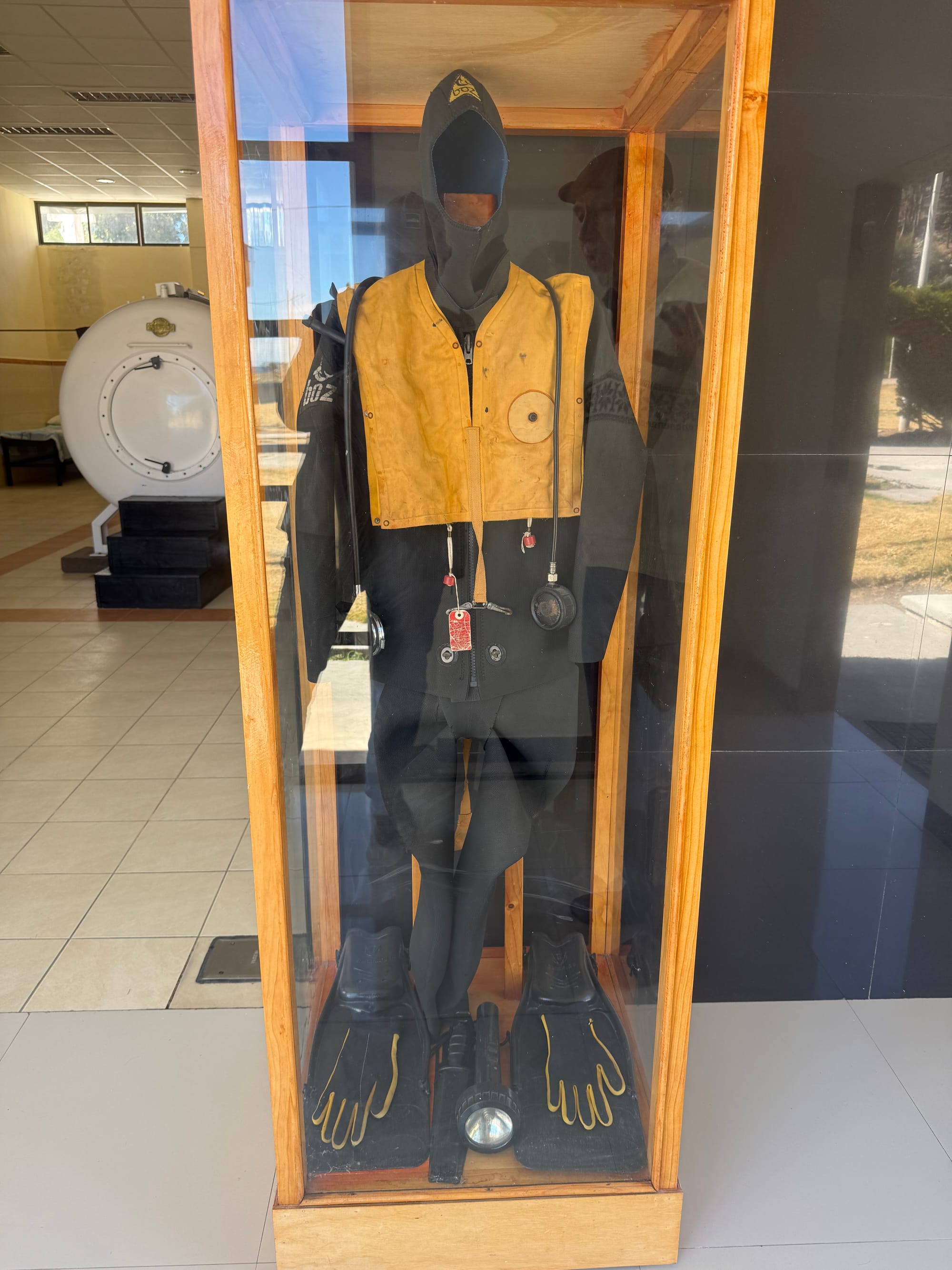
He took us through a door at one end of the building. I paused just inside to photograph a vintage diving suit standing in a glass case — the full canvas-and-brass arrangement, the kind of thing that looks less like equipment than like a person who left.
Then I looked past it into the larger room and full-stopped for a different reason.
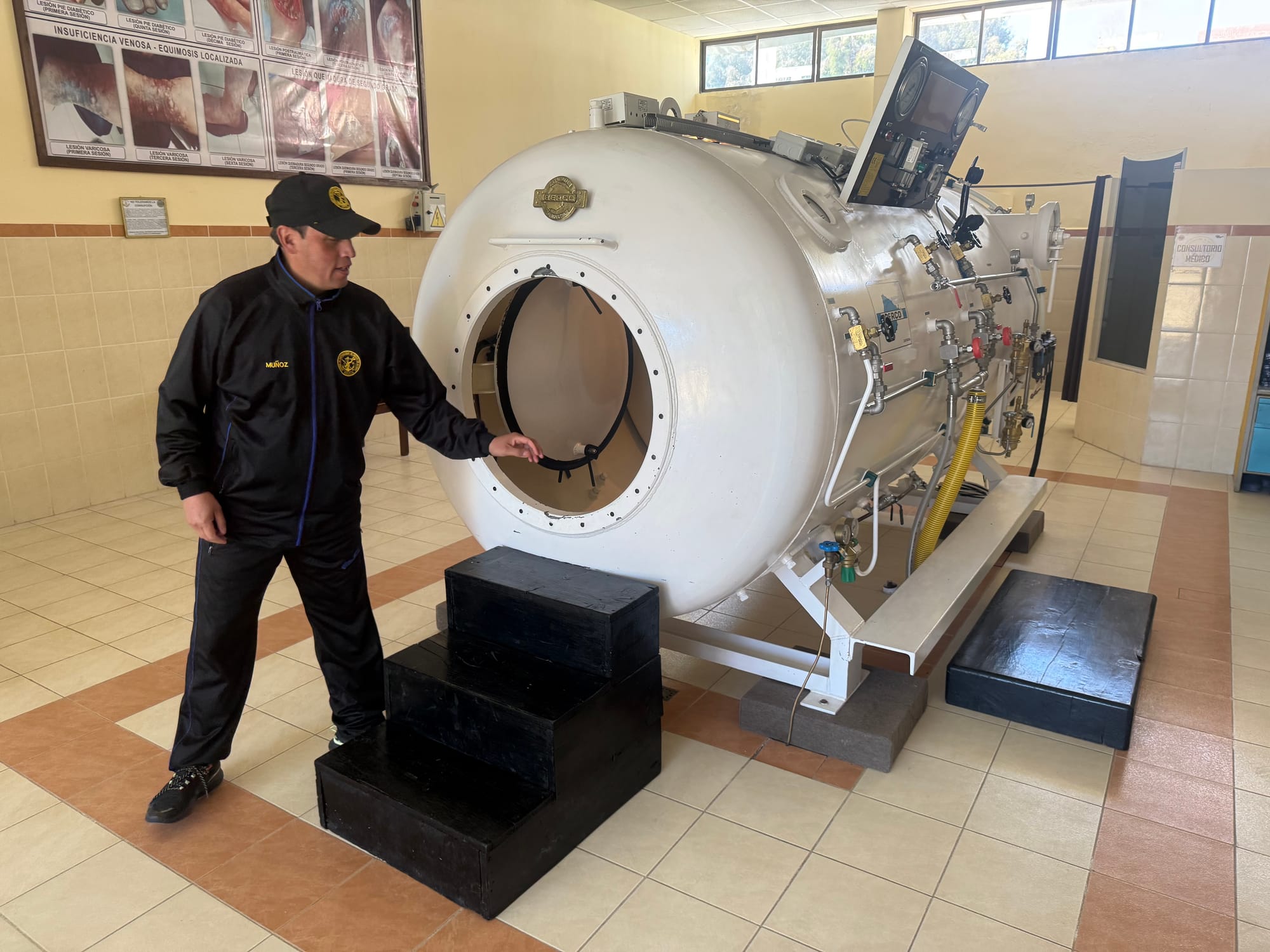
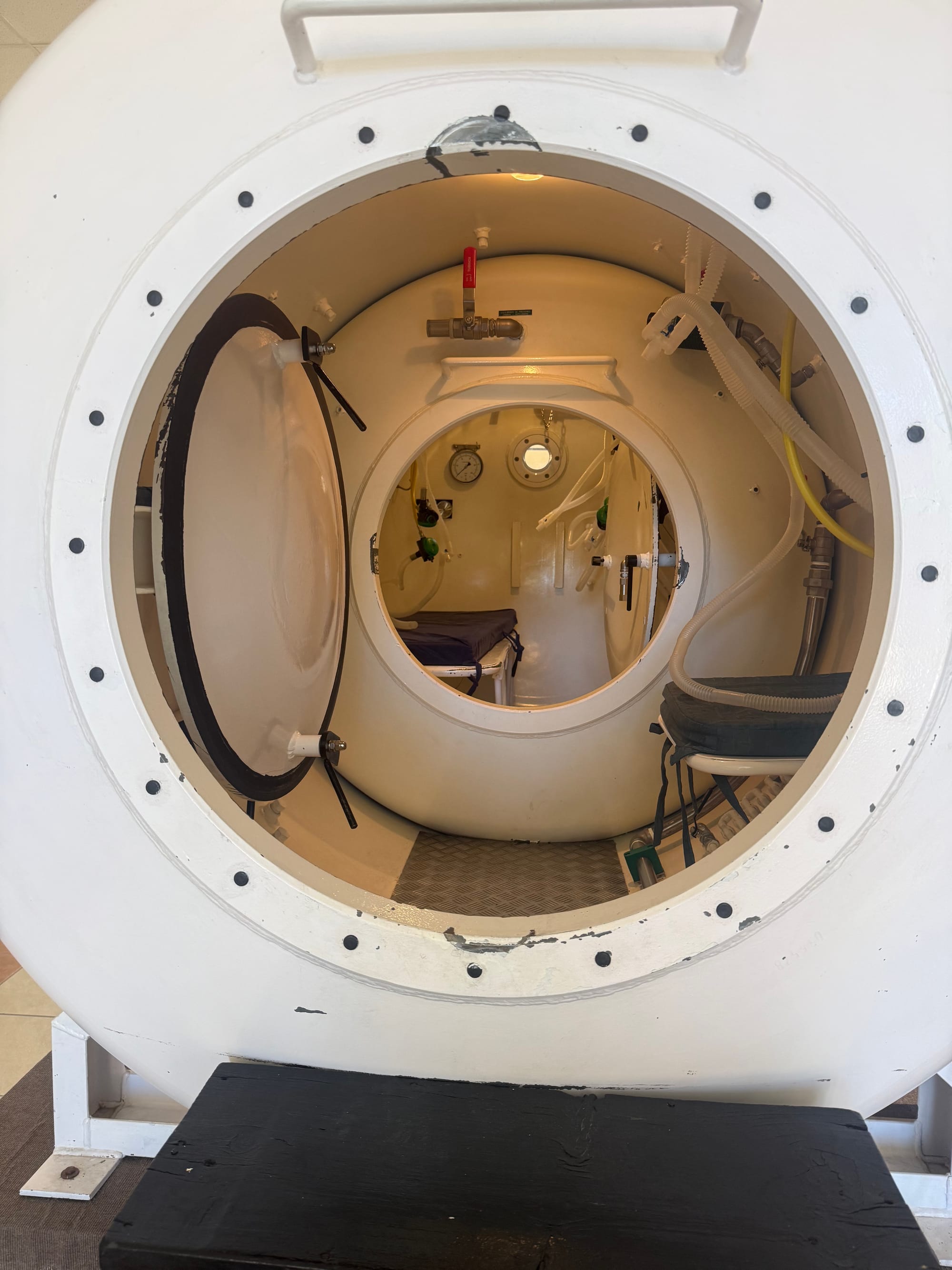
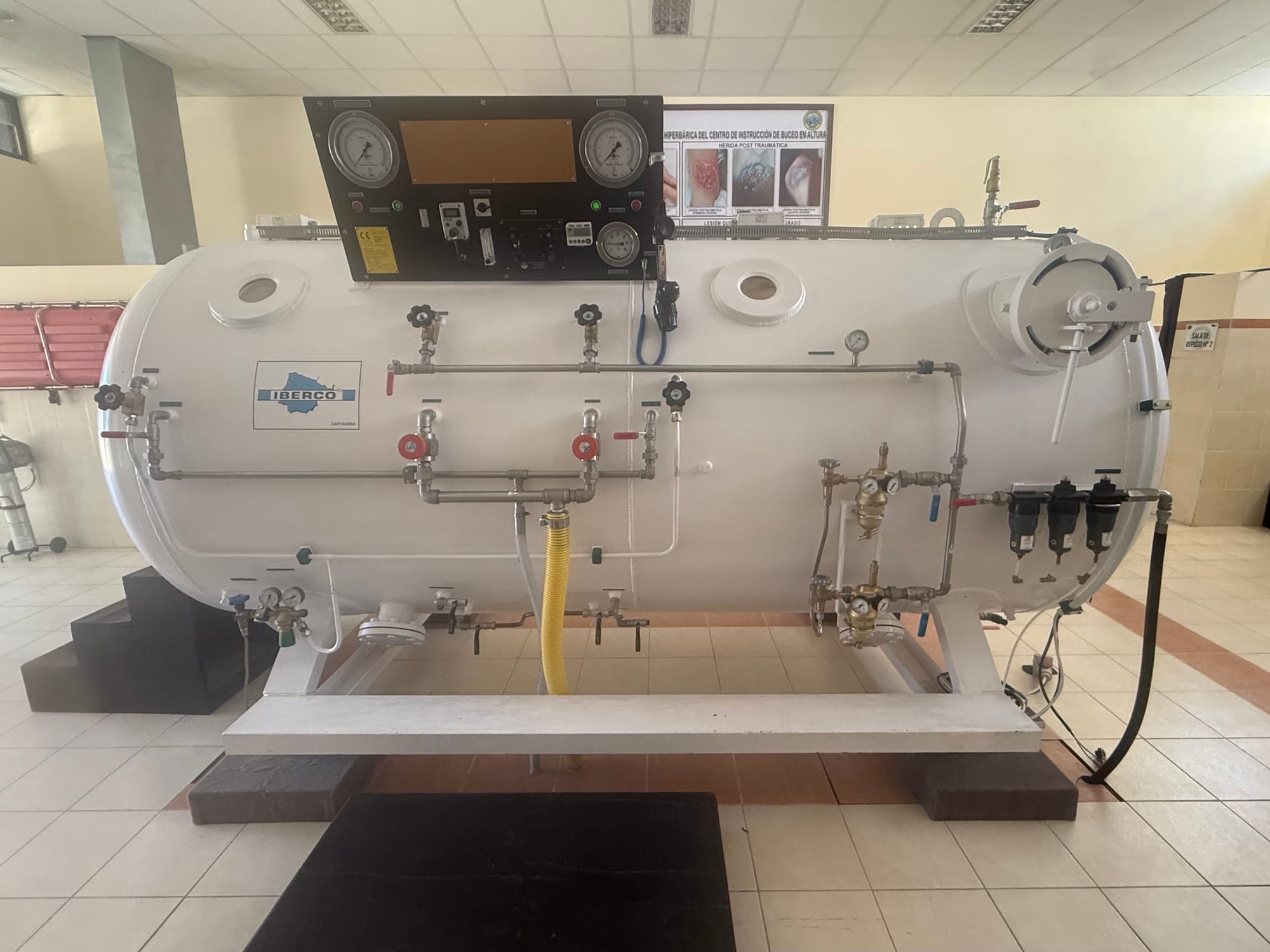
A white cylinder perhaps the length of a small vehicle sat on cradles, covered in valves, gauges and plumbing. My first read was submersible. A circular hatch at the near end stood partly open to the inside and I leaned around to see in, which I thought I was doing discreetly.
Dr. Muñoz noticed, swung the hatch wider, and explained — in terms calibrated for a two-time gringo diver — that it was CIBA’s multiplace hyperbaric chamber. The plate on the end reads Iberco, Cartagena — model IB-150, built November 2009. It came up here in 2010 and it is still the only chamber in the world operating at this altitude.
Inside the chamber, there is a second pressure compartment behind its own hatch, a cot, and an assortment of hoses, fittings and gauges. The chamber will accommodate eight persons total: five in the main chamber, three in the antechamber.
Anyone who wants to dive goes into that chamber first, before ever entering the lake. Capitán Villarroel, the center’s commander, calls it the prueba de fuego — the trial by fire. It isn't a test of nerve, or of how you'll handle decompression. It is simply the only way to find out whether your ears will equalize under pressure. If they won't, you learn it here rather than at nine meters, and you learn that you are not going to be a diver.
It isn’t only for divers. The same chamber runs hyperbaric oxygen therapy — the panel on the wall behind it tracks diabetic foot ulcers, burns, varicose and post-traumatic wounds, session by session, first through tenth. That was the intention from the moment it arrived. In a country with one multi-place chamber, the dive school and the clinic are the same room.
He continued the tour from outside while I worked out privately that I would rather take the bends than spend two minutes sealed in there.
I concluded that I would do it, if I had to. With a handful of Xanax going in.
Two Experts And A Tourist
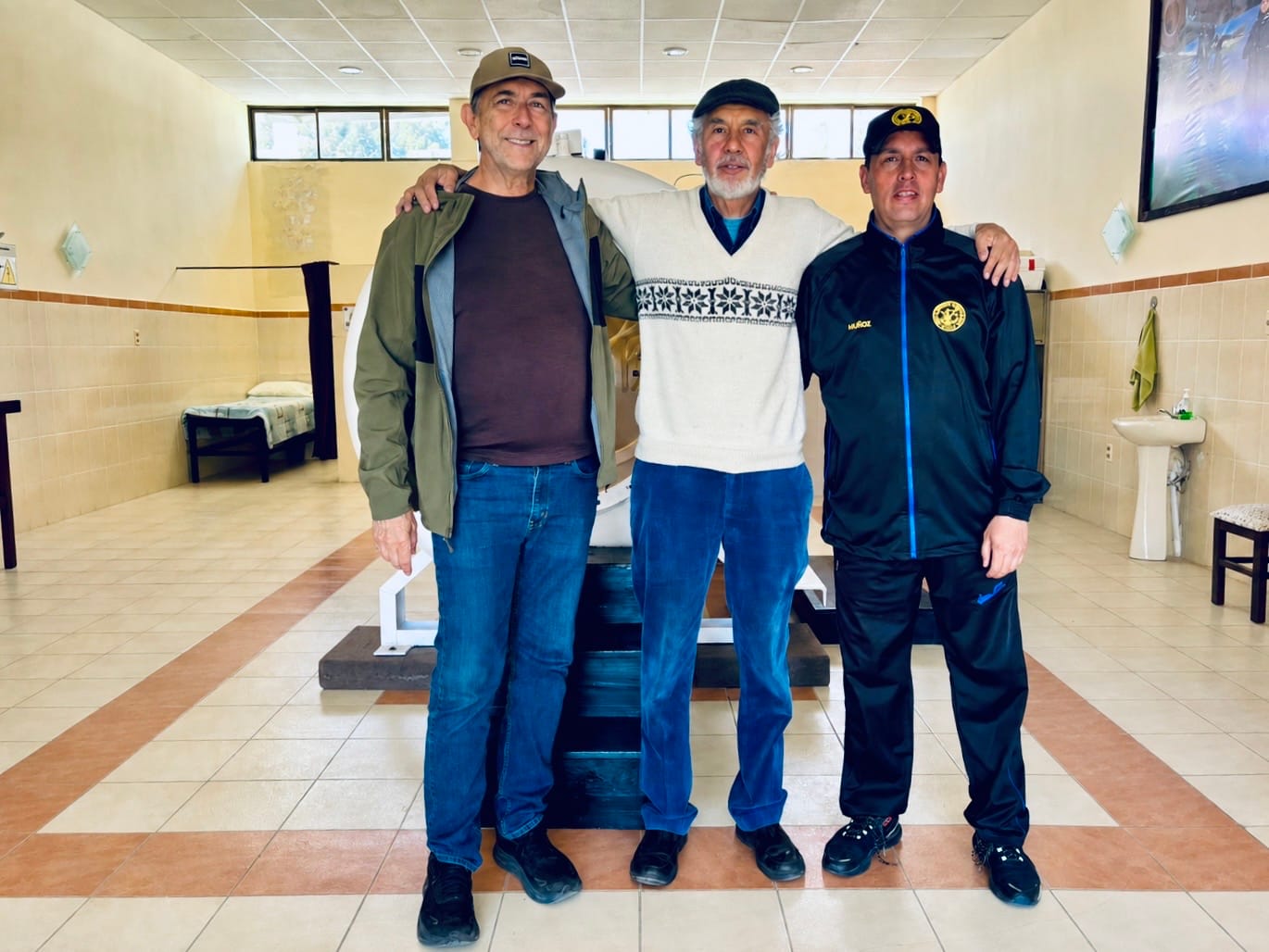
While Muñoz was kindly fielding my amateurish questions, he and Gustavo were carrying on a second conversation over the top of mine — decompression physiology, residual nitrogen, table corrections — in a tone two people might discuss how to operate a lawnmower.
Gustavo is a high-altitude physiologist. Twenty years ago he and a Danish colleague published a method (1) for converting sea-level dive tables to high-altitude use, worked through specifically for Lake Titicaca, and the Bolivian navy’s dive school has been using their tables since. His father, an ex-military physician, and pioneer in mountain medicine, helped arrange that.
I’d known about the tables for years. Standing next to the chamber was the first time I understood what was actually in them.
The problem comes to this. (Well over my head — pun intended — I’ll take Gustavo’s word on what follows…)
Diving at Titicaca is not the same as diving to the same depth in the ocean. The surface you return to sits at about two-thirds of sea-level pressure, and decompression depends on the ratio between the pressure at depth and the pressure you surface into. So a lake dive has to be planned as a considerably deeper sea dive. Their conversion for Titicaca is a factor of about 1.59.
Which means thirty-eight meters down in that lake is decompression-equivalent to roughly sixty meters of seawater.
An asterisk on that 38/60 number, since it’s the kind of thing that gets repeated carelessly — including by me. The conversion applies to decompression and nothing else. The actual pressure at thirty-eight meters in Titicaca is much lower than at sixty meters of ocean, so narcosis and breathing-gas density are correspondingly milder. What the lake takes from you is the decompression, not the depth. And sixty meters on air is an older convention; current practice stops well short of that. (Thanks to a couple of divers who thoughtfully pointed that out to me!)
Navy divers here are working at sixty to seventy meters. Call it 96-112 meters of seawater in decompression terms. That’s past what air will do under anyone’s rules, which is why helium was mentioned, along with rebreathers and surface-supplied helmets. Nitrogen is the bad guy twice — it’s most of what the tables are accounting for, and it’s what makes divers stupid at depth. Helium does neither.
And they are planning to go further. The figure I heard was a hundred and thirty-five meters, on a helmet.
(It’s these same Navy divers who are called into action when one of the barcazas sinks, though the strait maxes out at about 21 m in depth — 33 m to a diver.)
I wrote 135 m in my notes at the time, without understanding it of course. A hundred and thirty-five meters in Titicaca converts to something like two hundred and fifteen meters of seawater. Not an incremental step on what they are doing now — roughly double it.
At that depth the pressure is near fourteen atmospheres and ordinary air would kill you outright, on oxygen alone, before anything else got the chance. The gas has to be mostly helium with the oxygen dialed far down. And the real difficulty is not the descent. A dive carrying that much decompression obligation means hours coming back up, and in this lake those hours would be spent in water near 10º C at the surface and closer to 5º C a little way down. At some point the limiting factor stops being physiology and becomes cold.
I stood there and thought about the cot inside the white cylinder, and understood a little better why it was there.
The Frogs
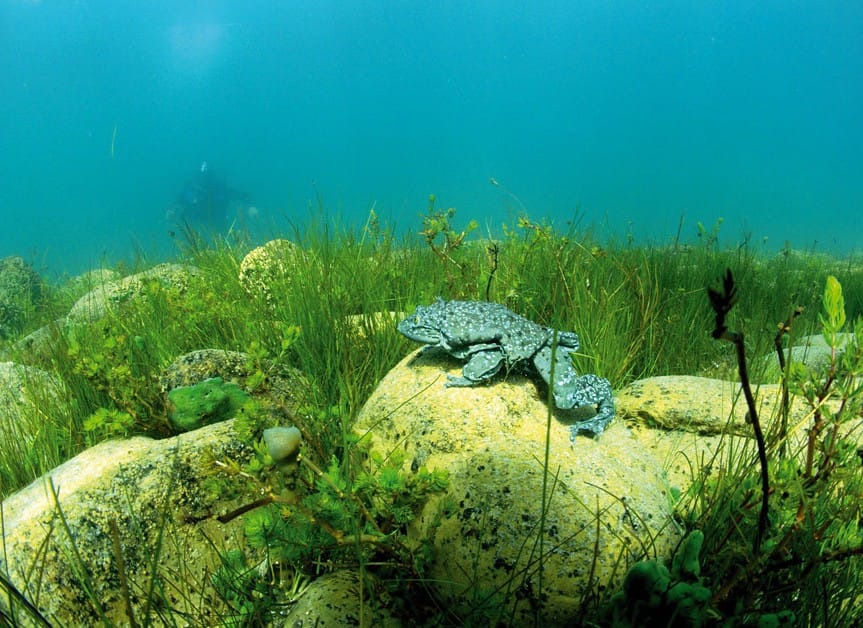
At one point, the conversation veered (hopped?) onto the giant Titicaca water frog, Telmatobius culeus — the giant, loose-skinned amphibian that Jacque Cousteau's expedition brought to the world's attention when they came here in 1968, looking for Inca gold on the lake bottom and finding, among other things, those creatures. (No gold, as far as anyone knows…) They‘ve become more and more scarce in the ensuing decades.
I was living in La Paz that year. I was eleven.
Divers around the Isla del Sol have lately been reporting encounters with a good many large ones; it's tempting to read that as recovery. The species is still listed as critically endangered (IUCN Red List), and a handful of sightings on a few dives is not a population trend, so I'll leave it as a question I would very much like answered in the affirmative.
It’s also, I'll admit, the first thing that made me think about bringing a dive housing down there. I‘ve spent decades photographing above the waterline. The idea of working at 3,812 meters, in cold water, on animals almost nobody has photographed properly, is the kind of idea at my age that I might be better off forgetting, though I’m sure that I won’t. In fact, I consider, just a dive without a camera might scratch that itch.
What CIBA Is Becoming
Recreational diving on the lake is picking up, and not all of it runs through CIBA. The school itself goes back to 1966, when the navy sent four students to Argentina to learn to dive. That's the safety problem here: a competent sea-level diver can arrive with every certification in order and no idea that the altitude has rewritten their tables.
The navy has been running a public sport-diving course for years. What’s new is a civilian Club de Buceo Deportivo. The base commander, Capitán Villarroel, has written a national regulation for altitude sport diving that was awaiting approval from the maritime authority at the time I visited. He has laid out four controlled routes, presently to about twelve meters. Everyone gets a medical evaluation, the chamber test, equipment familiarization, and the first dive — he calls it a bautismo.
What struck me is the shape of it. A dive operation and the region's only recompression chamber, in the same building, run by the same people. Most dive tourism in the world is not organized that way. Here it is, at the top of the world, more or less by accident of it being a navy.
Now I’m thinking even more about that bautismo dive.
The Monitor
Toward the end, Muñoz mentioned equipment the center needs. What I understood him to want most was a patient monitor — heart rate and ECG, blood pressure, oxygen saturation.
I said I'd look when I return home.
I've since realized I should’ve asked a better question before I start looking, because there are at least three different pieces of equipment hiding inside that request depending on whether it goes inside the chamber under pressure, monitors a patient inside from the outside, or simply sits in a room for evaluations before and after a dive. Those are not interchangeable, and one of them is expensive in a way my budget wasn’t built for.
So: a question first, then a search.
We drove Dr. Muñoz back to the town square, still talking, and let him out there.
Then Gustavo, Lucrecia and I continued on toward Copacabana, and toward the island, and toward the other reason I had come.
A week later a national paper ran a long piece on altitude diving in Titicaca, with Capitán Villarroel explaining publicly most of what Dr. Muñoz had walked us through in that room.
I‘d thought I’d stumbled onto something obscure and esoteric.
I’d just been a week early.
(1) Paulev, P.-E., & Zubieta-Calleja, G. (2007). High Altitude Diving Depths. Research in Sports Medicine, 15(3), 213–223.


