


I had been in Santa Cruz barely twenty-four hours, and hadn't so much unpacked as emptied everything into one large pile on the floor. So the morning we left, I packed for the trip north by fishing through that pile — the new waterproof duffel, the camera gear distributed across two backpacks, the camp stoves still needing gas canisters. We stopped for those on the way out of the city, had a brief scare when we thought we'd left William's phone behind, found it lying on the floor of the vehicle, and pointed the Hilux north and east under a light, overcast drizzle.
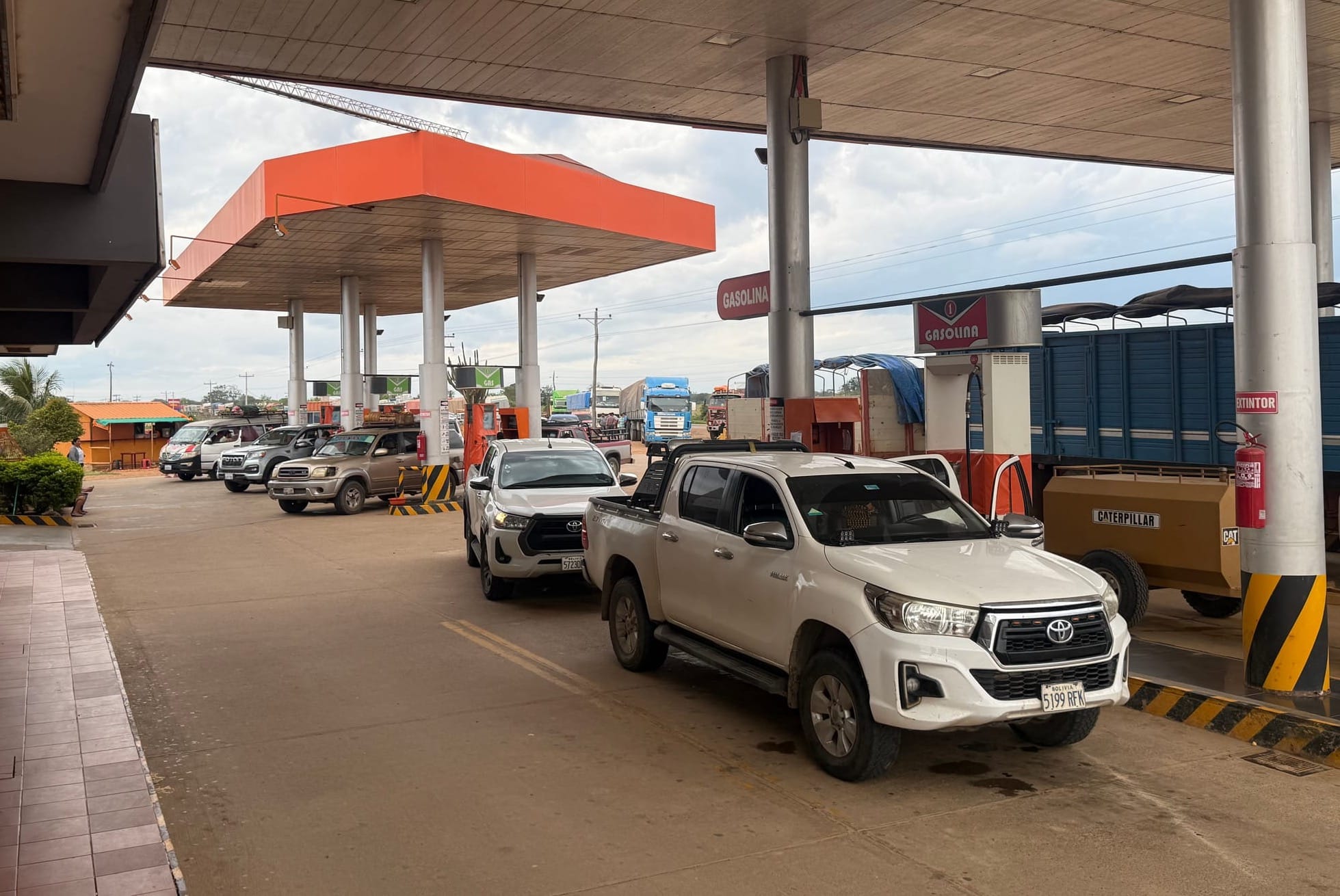
Gasoline
The first thing the road teaches you, this year, is that fuel is not a given.
Bolivia is in the middle of a fuel scarcity, and the further you drive from Santa Cruz, the more the ordinary act of filling a tank becomes a small expedition of its own. There are limits — forty liters per ID card at the pump — so I'd come prepared with my wife's and sons’ cards (all three are Bolivian nationals) for the days we'd need more. We carried extra in thirty-five-liter, plastic bidónes, topping them up wherever we could, watching the gauge with more attention than the scenery.
We had, in all my supposedly careful planning, overlooked one detail: that Thursday was the 6 de agosto, Bolivia's Independence Day — and the Bicentennial plus 1 at that. Which meant that somewhere around Concepción, with the tank drying up and no fuel to be found in town, the holiday quietly amplified the scarcity, closing every option we'd assumed might be open.
What got us through was not planning. It was people.
We were on the phone with Marcelo — the park ranger who is the on-location anchor of this whole effort — when he handed his phone to the man whose estancia he'd reached that, down near the Refugio. (Marcelo was scouting options for crossing the Bajo Paragua, but would discover there remained too much water… and alligators.) The man introduced himself as the former director of FAN, the foundation that once helped administer this very park. A gracious conversation with a complete stranger, at the exact moment I needed one. He knew people. He made a call. A gasoline reseller in one town, another up in San Martín, and suddenly the road ahead had fuel in it again. When we finally tracked down the first reseller — a small store off the plaza, hard to find in the winter dark — the woman selling it asked if we were headed to see Jaime. Of course she knew him. He'd sent us. We were, from that moment, treated like family.
I have driven in a lot of places. I'm not sure I know another where being stranded resolves itself, twice in one evening, through the kindness of people who owe you nothing.
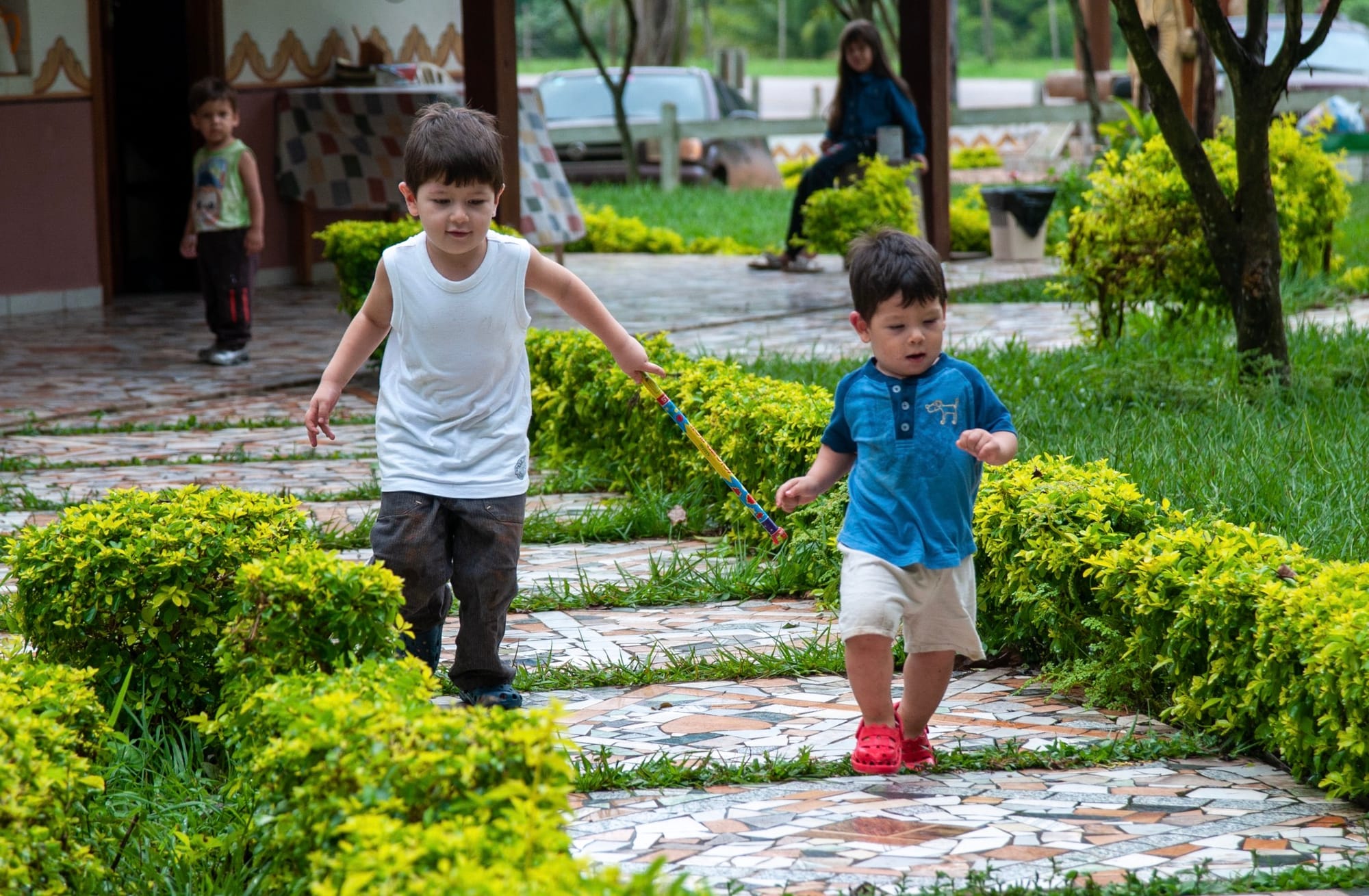
Las Piedras
Half an hour before Concepción, I pulled off at a small place called Las Piedras, named for the immense boulders on the property. I'd stopped there before — first in 2009, on the way to our younger son's baptism in Concepción, both boys small then; last in 2019, on the way to our wedding at the same 18th century Jesuit mission. There's homemade buffalo cheese, which is reason enough to stop.
It didn't look open. No one appeared. I let myself through the unlocked gate, motioning to William to drive into the parking area, and climbed the stone steps I'd first climbed fifteen years earlier — and a tall man, fortyish, who reminded me of an actor whose name I can’t recall, came out to meet me. We ended up talking for half an hour: Uyuni, Concepción, the lithium mines where he'd once worked, the paiche TikTok queen (Google it…!) the twelve years he'd lived in Concepción when he was married, which he spoke of a little wistfully. He'd recently come back to help the owners restart the place.
When it was time to go, we made our way to the car the way you do with someone you've just met but somehow already know — stopping every five or ten meters to finish one more thought. He opened the gate. We drove on. We didn't take photographs; the place was closed and under repair, and some moments you just leave as they are.
Santa Rosa de la Roca, golden hour
We came into Santa Rosa de la Roca in the last good light, the sun behind us, the Hilux throwing a long shadow down the road ahead. It was so beautiful I didn't want to take the camera out and spoil it. All around, the forest was coming alive with the evening. It's a place — this whole stretch of country — that has always made me feel good.
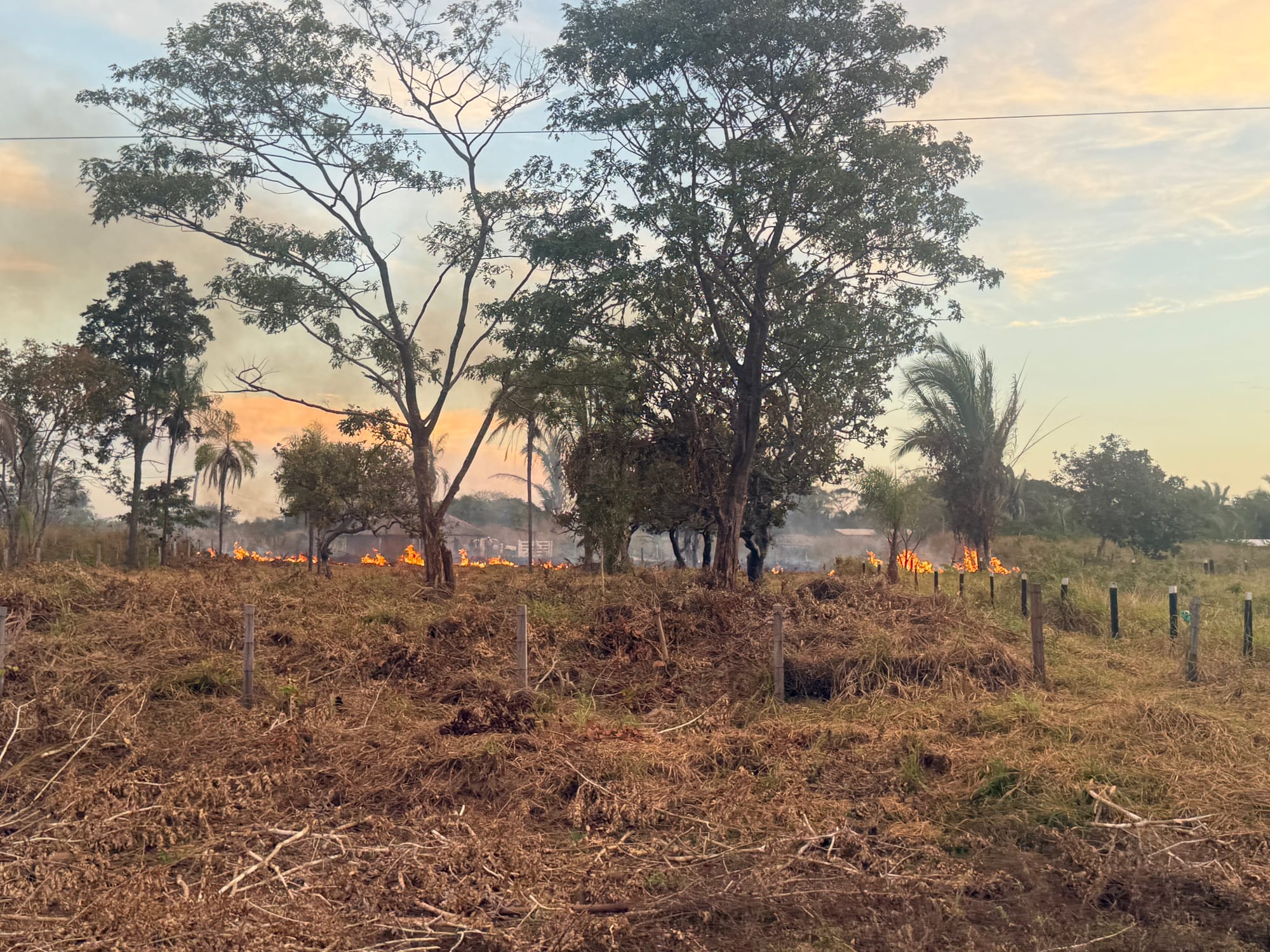
Behind us the sky was on fire, the colors deepened, I suspect, by smoke from the fires we knew from our maps were burning out there somewhere, unseen. No sooner had I written that thought down than a burning field appeared right alongside the highway.
I'll tell you something I noticed about myself in those hours. Back in Concepción, when our fuel had almost run out and I genuinely didn't know whether we'd push on or have to turn back, I found I didn't much care which way it went. I wasn't anxious. I was just living where I found myself. That feeling stayed with me the rest of the trip, and it may be the truest thing I brought home from it.
The mercado, and a check picked up
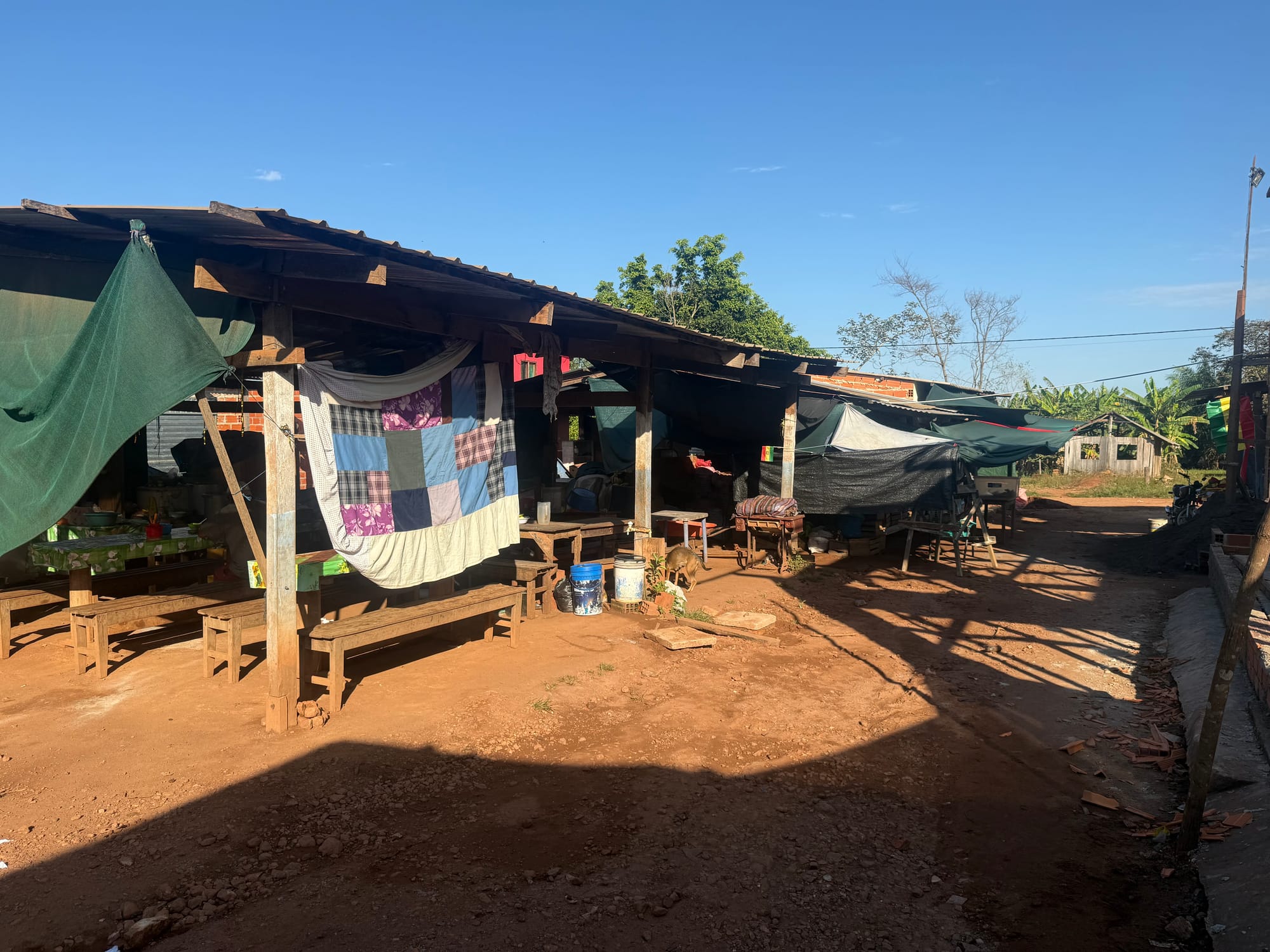
Morning in San Martín, after a restful and well-earned sleep at the only hospedaje in town with running water. Out early for a coffee quest — no reviews to guide you in these parts — which landed us at the local market beside the bus terminal. I ordered scrambled eggs, and after my last cholesterol report decided I'd rather not know what they were scrambled in. The breakfast sandwich turned out to contain what I'm fairly sure was bologna. Who knew we'd find Italian cuisine out here?
Our table mates were a couple — he from Lima, quick-spoken and warm; she from Trinidad, with the easy calm of the Beni. Traders, they travel all over Bolivia. As they got up to leave, we told the owner we had their check — twenty bolivianos, no great act of heroism — and their faces did something wonderful: for a second they genuinely thought we were pulling their leg. Then they sat back down, and we shared stories for another twenty minutes. That's the whole transaction of the road, really. You buy a stranger's coffee and get half an hour of their life.
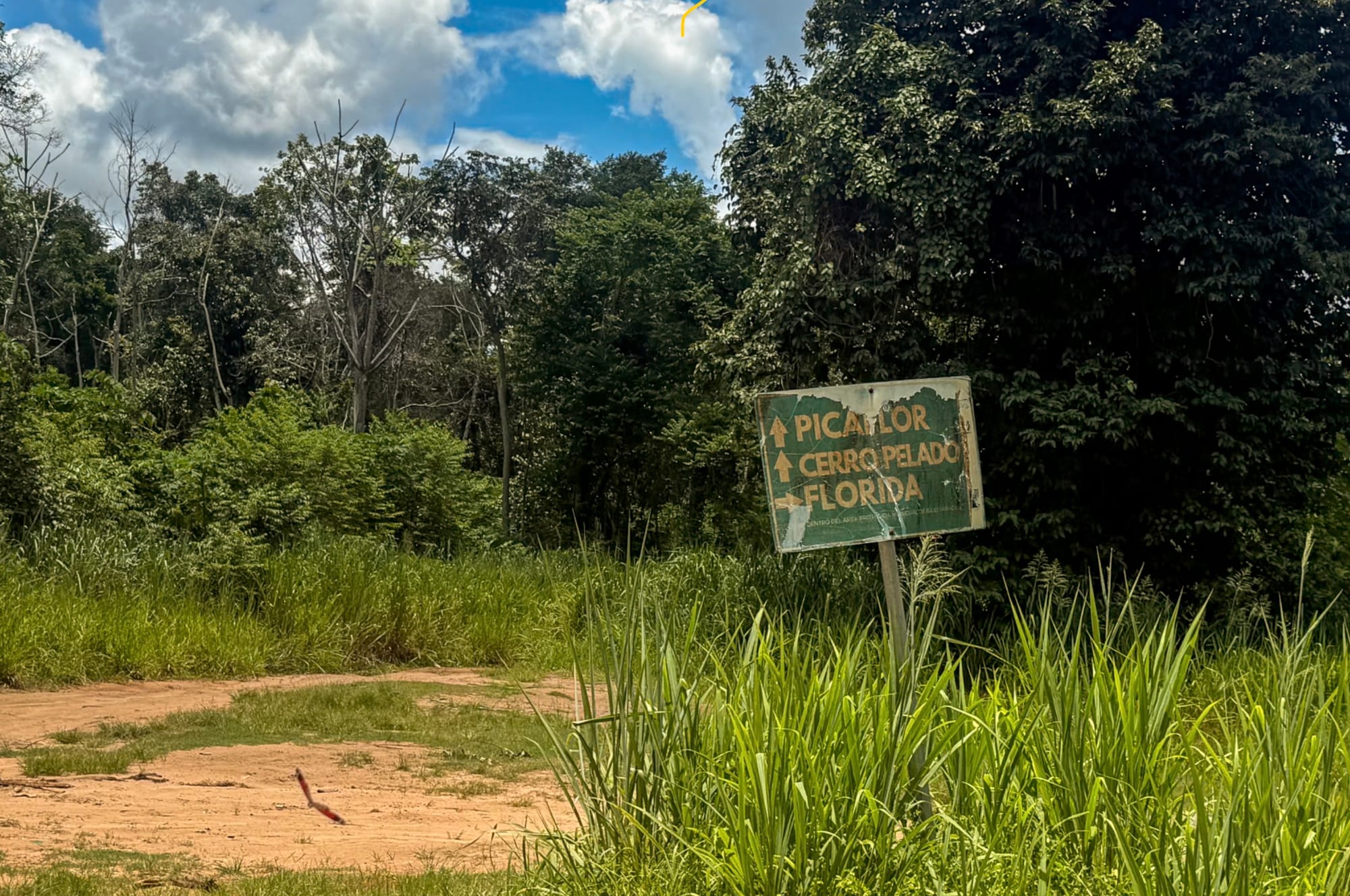
The turn
A hundred kilometers to the Florida turnoff, then maybe thirty-five more to the town, more or less due east — though I wonder whether anyone really tracks cardinal directions anymore, GPS having quietly retired the skill.
The road tells you what the region lives on. About a kilometer before the turnoff, a logging truck had lost a couple of wheels and sat paralyzed across the road; when we reached the junction, half a dozen more logging trucks were waiting for word that it had been cleared. We slipped past — the advantage of a smaller vehicle — and turned onto the single lane toward Florida, the surface pocked with old waterholes, bumpy and choppy in stretches, then, closer in, unexpectedly kind. Little roads branched off the main one the whole way; William named them for what they are.
Palms began to take over from forest. We’d taken them at first for açaí, but they're totaí — a spiny lowland palm that tends to mark land that once saw cattle and fire and use, and then went back to itself. Which fit: the ground had the look of having been worked once, long ago, and then left. We backed up once to let a tractor pass, its plow blade nine feet across.
We rolled into the guardaparque camp a little after three to find Marcelo on the porch, waving us into a parking spot, grinning. A cold drink in the kitchen, the Starlink coaxed to life off the car battery and then, encouragingly, off a solar panel. Marcelo gave us the history of the station and the town, and I'll only say it's complicated — the way so many long-standing troubles are, the ones that look from a distance like they ought to be simple to fix and never are, least of all once they've gone on for years.
That night: fried chicken, rice, salad, some fish, and a great deal of talk about the history of this park. The Milky Way came out and stretched clear across the sky, roughly east to west, and from the town came the drums of the Independance Day celebrations. Somewhere in the conversation it landed on me that when I do finally enter this park, I'll apparently be the first non-official visitor to go in for nearly ten years.
Ten years. Sit with that a moment. I did.
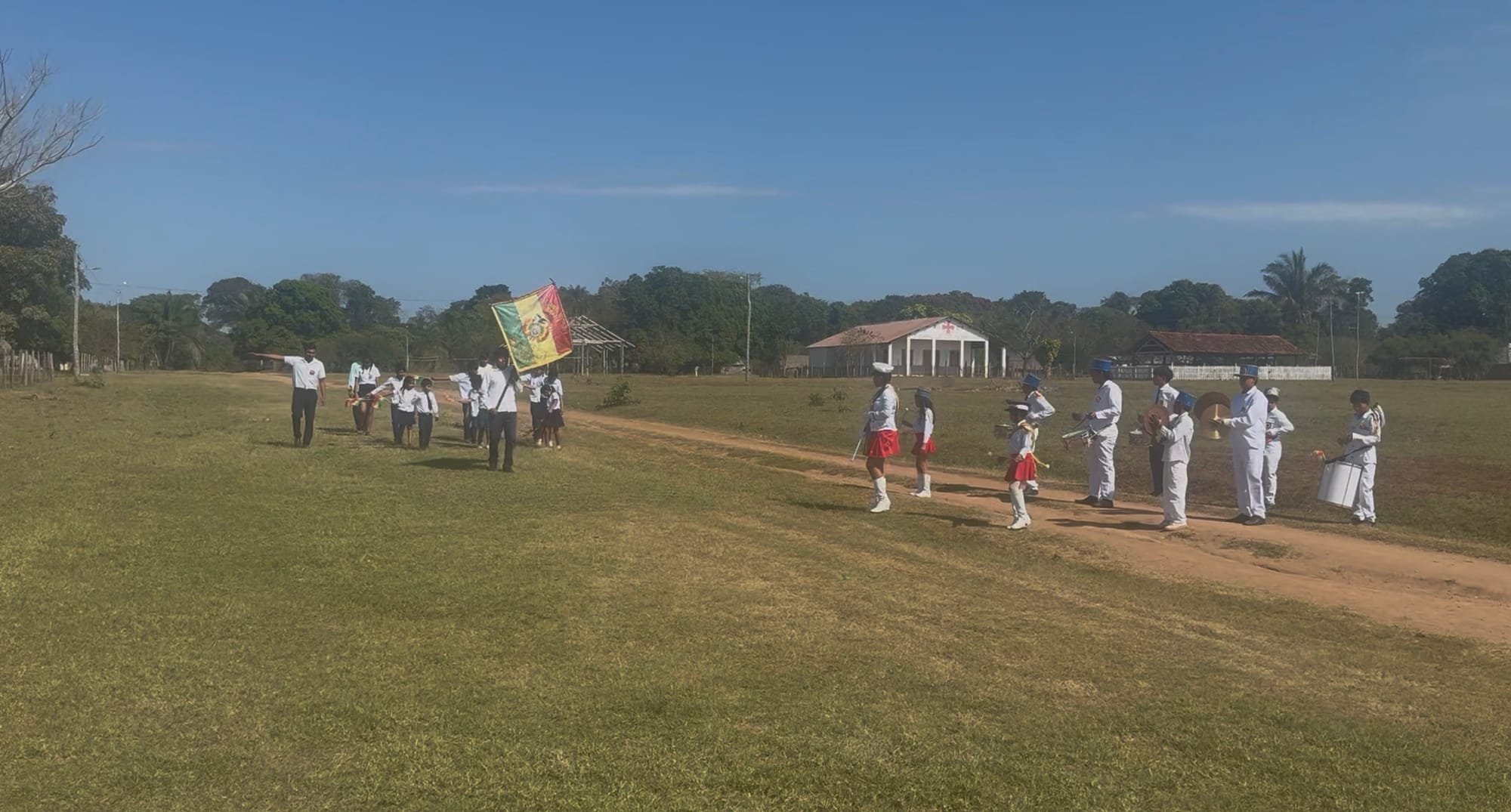
The desfile
I had it in my head that the parade — the desfile everyone kept mentioning — would be at eight in the evening, and had been quietly wondering how they meant to pull off a parade in the winter dark. It took me an embarrassing while, the next morning, to understand I'd been twelve hours off.
We came around the corner of the plaza — proportionally enormous for a town this size, a good hundred and twenty meters across — and Marcelo stopped the car. Across the square, young people in white shirts stood facing a stage in front of the school, where a few adults were seated, a Bolivian flag lifting in the light breeze. The national anthem was playing. We held where we were until it finished, then drove around and parked at the far corner.
I stayed in the car at first, in my boot — a broken foot keeps me from standing long — and, if I'm honest, not wanting to be the tall gringo who materialized out of nowhere and pulled focus. Marcelo went over. William followed, off to one side, filming on his phone and an Insta360. An older boy lined up four of the younger ones and, like a drill sergeant, made each state his name, insisting the last one say it louder, then louder again, to giggles from the rest. He put them through push-ups and asked each what the Patria meant to him — more giggles. Then a traditional dance, and the drummers started up, and I could feel a parade coming.
And I got tired of being a spectator. So I joined it. We filmed the bands, then fell in behind a group of four in matching, official shirts, at a respectful couple of meters — learning only at the far end that we'd been meant to march at the front, though nobody seemed to mind how it turned out. I met the town's mayor, its cacique, and we talked a little about his hope of bringing back the tourism that once made this place go, and that its loss has cost it dearly. Afterward a few people stayed to have their photos taken, and I happily obliged. (They saw the Z8 and smelled a pro!) I'll edit them at home and find a way to get them back to Florida.
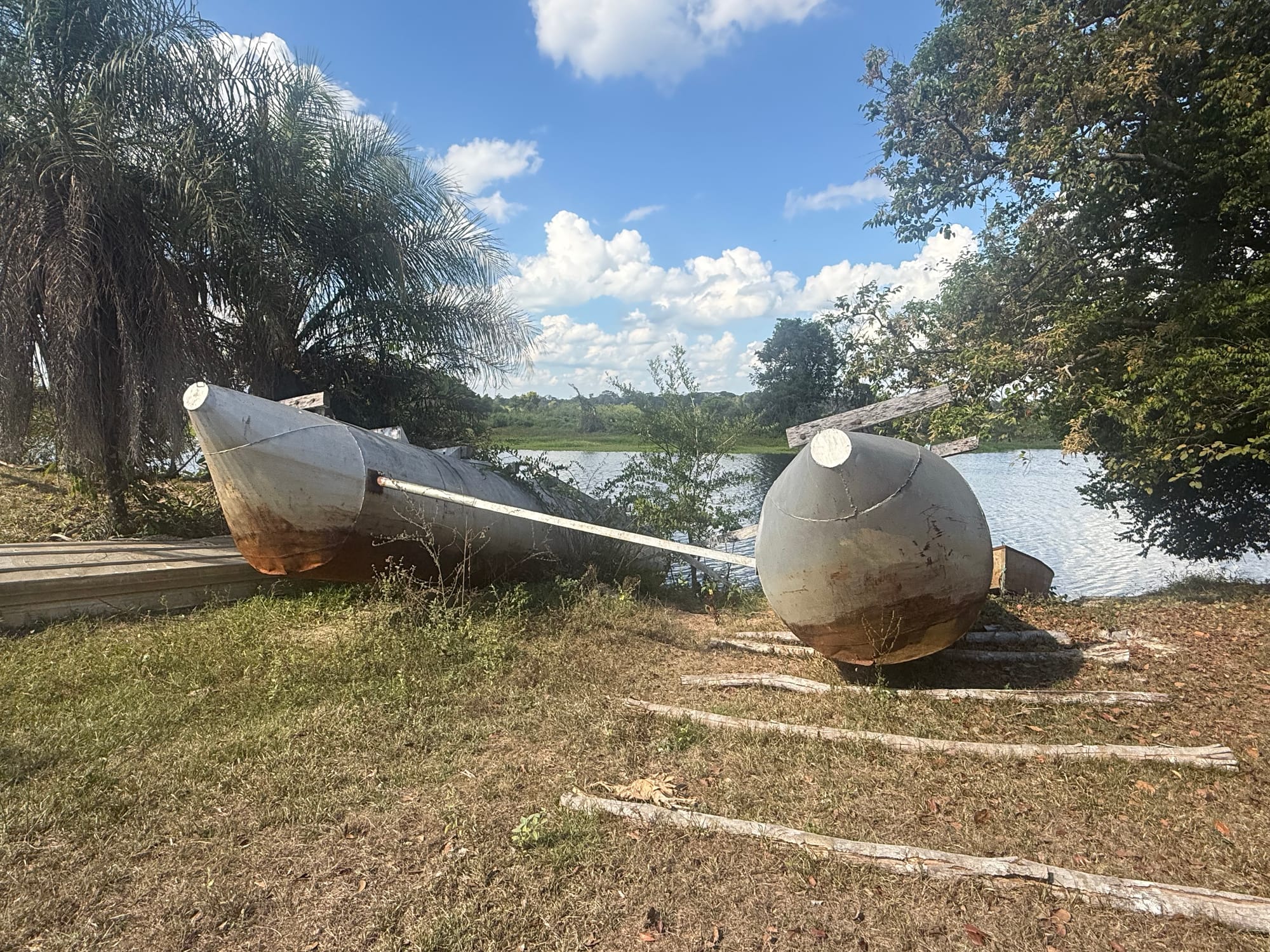
The pontoon
The crossing into the park, historically, is by pontoon — a cable-drawn platform capable of carrying a vehicle across a stretch of the Bajo Paraguá about thirty-five meters wide, where the water runs deep enough, maybe ten meters, to float it even in the dry season. Just upriver it shallows to perhaps a meter.
It isn't running now. The original post — cuchi, which Marcelo tells me is the hardest wood in Bolivia — still stands where the cable anchors, the cable itself now rusted and half-buried under dirt and leaves. The pontoons need the rust treated on their undersides and the wooden frame on top restored. Marcelo can't watch over the site regularly; it's twenty minutes from camp, and there's the matter of fuel just to get there.
Standing at the crossing, we did what people do at a broken thing they love: tossed around ideas, some sensible, some wild. William asked his AI what a permanent bridge might cost. About 1.2 million dollars, it said — with, as these things go, a great many variables.
More usefully: the pontoon belongs to the park. Marcelo and the Alcalde both confirmed it. So I floated a smaller idea — that we might repaint it, in the park's official color, once the proper permission comes through from the central office. Both agreed at once. I'll take measurements and run them by friends of mine at a Bolivian paint company, for the quantity and the right formula. A small thing. But small restored things are how larger ones begin.
On the way back we passed under the tin roof of a sawmill, closed for the holiday — a hundred meters long, stacked with beautiful milled boards, ringed by machinery old enough to have stories and apparently still equal to the work. I spent a happy half hour photographing the tools and the light in that place. Some stories the pictures tell better than I can.
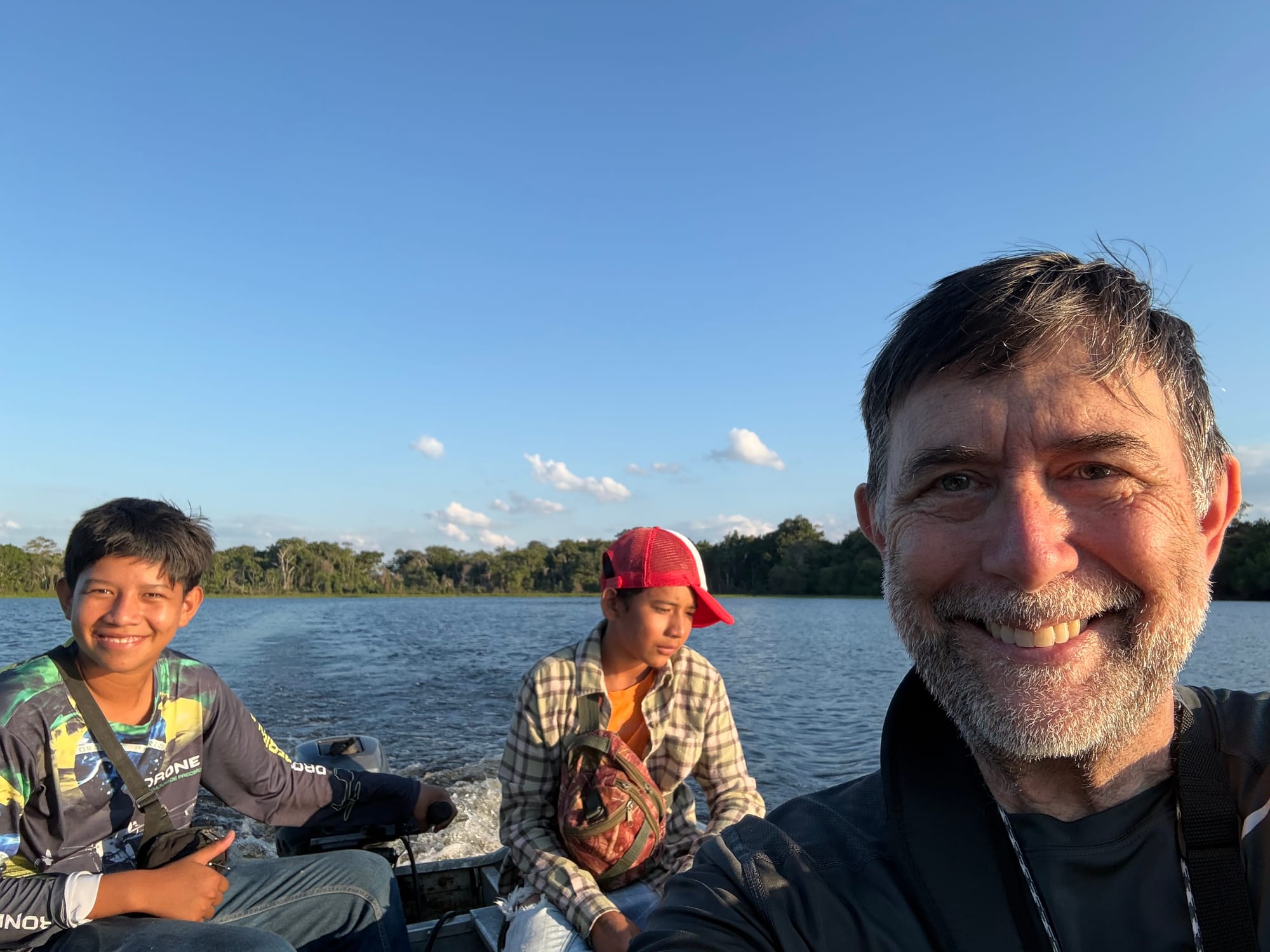
Mario's boat
Before dinner, three boys — fourteen, maybe fifteen — took us out on the river. Mario, the middle one by size, declared himself the owner of the boat, which gave me and the other two something to do: we openly conspired about how we might commandeer it and make off without him.
We ran a loop around the bay — an old cutoff bend of the Bajo Paraguá, with the town of Florida on its bank — then turned upriver, past the camp, and put in on the far side (still not park land; no rules bent, as my access permissions remain a work in progress). The boys headed off through the grass to fish the other side of the little peninsula. William and I went along a while, then hung back; he launched the drone, and after I'd tried the goggles I walked back to the boat and sat down with the camera to wait.
The sunset was outrageous — one of those blazing ones I'd almost stopped photographing because out here they'd become nearly routine. A kingfisher landed on a branch near me, then gave way to a limpkin. The light was going, my ISO climbing on auto, wide open at 2.8; when the bird finally lifted off I suspect my shutter was too slow to hold it sharp, though I got a few while it sat. We'll see.
The mosquitoes found me as the twilight deepened, and I waved them off and stayed put, because the peace was, as I wrote in my notebook that evening, deafening, and I wasn't going to trade it away over a few bugs. I began to wonder whether the boys had decided to make a night of it out there. Eventually they came back, of course. And in the morning I hadn't a single bite — some luck of genetics and chemistry — while William, beside me, had had a very different night.
We turned for home the next morning, early, to buy ourselves some daylight against the long drive and the uncertain gasoline. Two totaí-loving agoutis (locally, jochi caluchas) darted across the road in the first half hour and then nothing. We left a full can of fuel for Marcelo's generator and carried the other. We spent a good night in Concepción, bought a couple of carved pieces from the woodworking school on the plaza, drank lemonade at a coffee house so well-loved it was overflowing, and rolled back into the noise of Santa Cruz the following afternoon — that small brain-shock of returning to the urban world.
The reconnaissance is behind us now. The real work is still ahead — the park itself, in October, when the season turns, the river at the Refugio dries, and the window opens. But I know the road now. And more than the road, I know a little more of the people strung along it, who fed us and fueled us and took us out on the river and asked for almost nothing back.
That was the point, it turns out. Not the destination. The road, and who's on it.
Next: back to the work.
From The Borochi Project — field notes on maned wolf conservation in the southern sector of Noel Kempff Mercado National Park, Bolivia.
Previously: ← The People Who Paved the Way


